A keynote begins, a panelist switches languages, a camera crew needs a cue, and the event director must reach three teams in different halls. The top event communication tools are not one product category. They are a coordinated set of systems that help audiences hear, speakers participate, crews respond, and organizers retain control when timing matters.
For corporate conferences, government summits, exhibitions, and hybrid meetings, the right choice depends on the venue, audience size, program format, languages, and level of production complexity. A small boardroom may need only tabletop microphones and a display. A multi-room international congress may require interpretation booths, digital name signs, production intercoms, licensed radios, recording, and managed technical support.
Top Event Communication Tools by Event Need
Conference discussion and microphone systems
For meetings where delegates need to speak, vote, or participate from assigned positions, a conference discussion system provides structure that handheld microphones cannot. Chairman units can give moderators priority control, while delegate microphones allow orderly participation without passing equipment across the room.
These systems work especially well for board meetings, ministerial sessions, annual general meetings, training programs, and policy forums. Options range from wired units for fixed room layouts to wireless systems for venues where cable routing is restricted or seating plans may change.
The trade-off is operational planning. Wireless microphones offer flexibility, but they require frequency coordination, charging management, and suitable RF conditions. Wired systems are often the more dependable choice for long sessions with fixed seating, particularly when the room can support discreet cable runs.
Simultaneous interpretation systems
When attendees need to follow presentations in more than one language, simultaneous interpretation is one of the most valuable event communication tools available. Professional interpreters work from dedicated booths or remote locations, while delegates listen through infrared or digital receivers and headsets on their selected language channel.
This is the standard approach for international conferences, diplomatic programs, investor meetings, medical congresses, and cross-border corporate events. It allows speakers to present naturally in their preferred language without extending the agenda through consecutive interpretation.
A successful deployment is about more than receivers. Organizers must confirm language pairs, interpreter positions, booth placement, sightlines to the stage and screens, channel allocation, and whether remote interpretation is appropriate. Remote interpretation can reduce travel requirements and broaden access to specialist linguists, but it depends on protected internet connectivity, audio routing, and a clear backup plan.
AI speech translation
AI speech translation can support multilingual access where live interpreters are not required for every session or language. It can provide translated captions, audio, or text-based support for town halls, workshops, product demonstrations, and hybrid sessions.
It is a practical option for content with predictable terminology and for audiences that benefit from on-screen language assistance. However, it should not automatically replace professional interpreters in legal, governmental, medical, financial, or high-stakes negotiations. Accents, specialized language, overlapping speech, and culturally sensitive phrasing still require human judgment.
The best approach is often a mixed model: professional simultaneous interpretation for principal sessions and AI-supported translation for breakout rooms, informal content, or audience captions.
Two-way radios for operational coordination
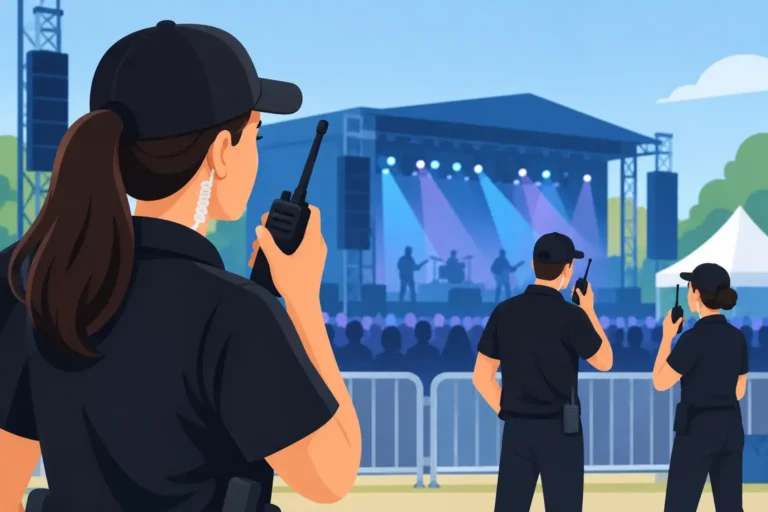
Front-of-house teams, security, registration staff, logistics crews, and technical operators need immediate communication that does not rely on personal mobile phones. Two-way radios provide direct, group-based contact across large venues, outdoor sites, exhibition halls, and multi-location programs.
For events in the UAE, radio compliance matters. TDRA-licensed radio communications help organizers operate professionally and avoid the uncertainty of unsuitable consumer devices. Radio packages can be configured with earpieces, speaker microphones, charging stations, designated channels, and call signs that reflect each operational team.
Radios are ideal for fast coordination, but they are not designed for private production conversations or constant stage cues. They work best when paired with a show intercom system and a simple communications plan that defines who uses each channel, what language is used, and how urgent incidents are escalated.
Show intercom systems
A show intercom is the control-room communication backbone for live productions. It connects the event director, stage manager, audio engineer, lighting operator, video crew, camera operators, playback team, and other key technical personnel.
Unlike radios, production intercoms support focused, low-noise communication during cues and program changes. Wired belt packs can be the best fit for fixed production positions, while wireless intercom systems support roaming camera crews, stage managers, and operators who cannot remain at a console.
For a conference with opening videos, walk-on music, multiple speakers, panel changes, and live streaming, intercom discipline can prevent small timing errors from becoming visible audience problems. The system should be designed around the run of show, not added after technical rehearsals begin.
Professional audio and audience reinforcement
Clear speech is the foundation of every event communication plan. Even the best microphones, interpretation systems, and remote platforms fail if the room has uneven coverage, feedback, distracting noise, or poor gain structure.
Professional audio systems are built around the room. Ballroom dimensions, ceiling height, audience layout, stage position, acoustic treatment, and partition walls all affect speaker intelligibility. A well-designed package may include line-array speakers, delay speakers, digital mixing consoles, wireless microphones, lectern microphones, confidence monitors, and recording feeds.
More speakers are not always better. In a smaller meeting room, excessive volume can reduce clarity and tire the audience. In a large conference hall, relying only on front speakers can leave rear rows struggling to hear. System design and experienced audio operation make the difference.
Digital name signs and speaker identification
At high-level meetings, identifying participants quickly supports discussion flow and enhances the room’s professional appearance. Digital name signs can display names, titles, company branding, country identifiers, agenda information, or voting status at each delegate position.
They are particularly useful for government forums, executive meetings, investor events, and formal conferences where participants are seated in a structured format. When integrated with a discussion system, they can help moderators and operators identify active speakers without interrupting the session.
This tool is less necessary for informal workshops or open networking events. Its value rises when protocol, branding, participant recognition, and meeting governance are central to the experience.
Teleprompters and confidence monitoring
Senior speakers often need more than a lectern and a microphone. Teleprompters help presenters maintain eye contact while delivering prepared remarks, while confidence monitors show presentation slides, timers, video returns, or notes in a position visible from the stage.
These systems are particularly effective for CEO addresses, product launches, awards ceremonies, broadcast interviews, and government announcements. They reduce the need for speakers to turn toward a main screen and can support more controlled delivery in front of cameras.
A teleprompter requires preparation. Scripts must be finalized, formatted for reading, and managed by a trained operator who can match the speaker’s pace. For conversational panels, a confidence monitor with speaker notes or session timing may be more useful than a full prompting setup.
Silent headsets and tour-guide systems
Silent headsets allow attendees to receive event audio directly without filling the surrounding area with sound. They are useful for exhibitions, product demonstrations, fitness activations, concurrent sessions, museum-style experiences, and venues with strict noise limitations.
Tour-guide systems serve a related purpose for site visits, factory tours, property walkthroughs, and mobile groups. A guide speaks into a transmitter microphone while participants listen through lightweight receivers. This keeps groups together without requiring the guide to raise their voice in noisy environments.
Both options improve the attendee experience where mobility or noise control is a concern. The practical decision is whether participants remain seated, move through a route, or need multiple channels for concurrent content.
How to Build the Right Event Communication Package
The best communication setup starts with operational questions, not a product list. How many rooms are active at the same time? Which sessions need multilingual support? Will speakers join remotely? Does the production team need private cueing? Are there outdoor areas, exhibition floors, or restricted radio environments? What must be recorded or streamed?
From there, a technical partner can match equipment to the actual event flow. A two-day leadership summit may combine conference microphones, simultaneous interpretation, digital name signs, teleprompters, show intercoms, radios, and recording. A roadshow may need portable audio, tour-guide systems, and wireless intercoms. The equipment changes, but the objective remains the same: every audience member and every operational team should receive the information they need at the moment they need it.
Rental is often the more practical model for these systems. It gives organizers access to current enterprise-grade technology without purchasing, storage, maintenance, transport, frequency management, or specialist staffing. DLC Events can configure rental packages around venue conditions, event scale, multilingual requirements, and branded presentation needs, with technical teams supporting setup, operation, and troubleshooting.
Before confirming equipment, schedule a technical review with the venue and production team. A communication plan built around real room conditions and a tested run of show gives speakers confidence, protects the audience experience, and gives your crew a clearer way to respond when the program changes.