A conference can have excellent speakers, polished visuals, and a full registration list, then lose the room because attendees at the back cannot clearly hear a question from the stage. This audio coverage guide helps event planners build a sound plan around what people need to hear, where they need to hear it, and how the room will behave once it is full.
Audio coverage is not simply about placing more loudspeakers in a larger space. It is the controlled distribution of clear, intelligible sound across an audience area without excessive volume, distracting echo, feedback, or uneven levels between the front and rear of the venue. For corporate meetings, summits, exhibitions, and live productions, that distinction affects engagement, accessibility, recording quality, and the perceived standard of the event.
Start the Audio Coverage Guide With the Room
Every coverage plan begins with a site survey or detailed venue drawing. Room dimensions matter, but geometry matters more. A low-ceiling ballroom with acoustic treatment behaves very differently from a high-glass atrium, exhibition hall, outdoor venue, or divided meeting space.
Identify the stage position, seating layout, ceiling height, wall materials, screens, rigging points, control position, entrances, buffet areas, and any areas separated by pillars or partitions. These details determine where sound can travel directly and where it may reflect, fade, or arrive late.
Audience configuration also changes the calculation. Theater seating concentrates listeners in rows facing the stage. Cabaret rounds spread guests in different directions, often creating more bodies and furniture between the loudspeaker and listener. Classroom layouts, U-shaped boardrooms, and exhibition presentations each require a different approach. A system that works for 80 theater-style attendees may not provide consistent speech clarity for 80 guests seated at round tables.
For high-stakes events, assess the room when possible at the same time of day as the program. HVAC systems, outside traffic, neighboring halls, and exhibition activity can add noise that is absent during an empty-room inspection.
Define What Must Be Heard
The right system depends on the content, not just the audience count. A keynote speech, panel discussion, awards ceremony, multilingual summit, and live music performance have different audio priorities.
Speech-led programs require intelligibility above all else. Attendees should understand every word at a comfortable level, including those seated at the edges and rear of the room. This usually calls for professional loudspeakers positioned to aim sound at the audience, paired with suitable microphones, digital signal processing, and an experienced audio operator.
Panel discussions need additional planning because multiple open microphones can create feedback risk and inconsistent levels. Gooseneck conference microphones, boundary microphones, handheld wireless microphones, or headset microphones may each be appropriate depending on the table layout, speaker movement, and visual requirements. A properly configured conference discussion system also supports microphone control, delegate identification, and orderly Q&A.
Live music, walk-on stings, videos, and product-launch effects require more headroom and fuller frequency response than speech alone. This does not always mean the entire room needs to be louder. It means the audio system must be specified for the most demanding moments in the run of show, then tuned carefully for the quieter ones.
Choose Loudspeaker Placement, Not Just Loudspeaker Quantity
Front-of-room loudspeakers are often enough for a small meeting room, particularly when the audience is close to the stage. As rooms get longer or wider, relying only on front speakers can produce a familiar problem: the front rows are too loud while the back rows struggle to follow the session.
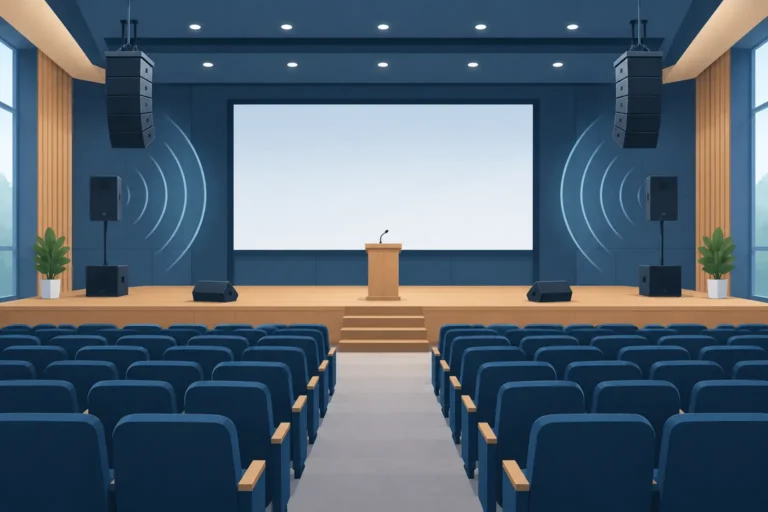
Distributed audio solves this by using additional loudspeakers along the audience area. These may be delay speakers placed farther into a ballroom, ceiling speakers for selected breakout spaces, or fill speakers that cover front rows, side seating, or areas blocked by stage structures. Each speaker zone must be time-aligned so attendees hear one coherent program rather than a noticeable echo.
Delay timing is a technical detail with a visible event outcome. If a rear loudspeaker is not delayed correctly, the audience may hear the sound from the back speaker before or too far after the sound from the stage. Speech becomes tiring to follow even when it is technically loud enough. Professional measurement, system tuning, and digital processing prevent this issue.
Speaker placement must also respect sightlines and event design. Equipment should support the stage environment without obscuring LED screens, branding, camera angles, delegate tables, or emergency pathways. For premium corporate events, well-positioned systems deliver clarity without drawing attention away from the message.
Coverage Zones That Often Need Attention
Some areas are routinely overlooked during event planning: rear seating, side seating beyond the main loudspeaker angle, registration or networking zones, foyers, overflow rooms, and backstage call areas. They do not all need the same program audio or the same volume.
An overflow space may need a video feed with synchronized audio. A foyer may require low-level program sound for guests waiting to enter. A backstage area may need a cue feed rather than the full room mix. Treating these as separate zones gives the production team better control and avoids disrupting the main audience experience.
Match Microphones to the Program
Clear coverage begins at the microphone. Loudspeakers cannot restore speech that was poorly captured at the source.
A lectern microphone is effective when speakers remain in position and the lectern is part of the presentation format. A wireless handheld microphone provides flexibility for awards, audience Q&A, and presenters moving across the stage. Headset and lavalier microphones work well for presenters who need both hands free, although their placement and gain structure need careful attention. For executive roundtables and formal conferences, integrated discussion microphones provide consistent sound while maintaining a professional tabletop appearance.
Microphone choice also affects feedback control. The more open microphones active in a reflective room, the less gain is available before feedback. Automatic microphone mixing, disciplined microphone muting, correct speaker placement, and appropriate microphone technique all contribute to stable sound.
Build redundancy into the plan for essential moments. A backup handheld microphone at the stage, spare batteries, alternative playback connections, and a fallback presentation audio path are practical safeguards. The cost of a backup is small compared with the disruption caused by a failed keynote microphone.
Plan for Multilingual and Hybrid Audio
International events require an audio plan that supports more than the floor language. Simultaneous interpretation systems route interpreters’ language channels to delegates using infrared or digital receivers and headsets. The main room loudspeaker system carries the floor audio, while each attendee selects the required interpretation channel privately.
This setup needs coordinated planning between the audio team, interpretation team, conference system, and video crew. Interpreter booths require appropriate audio feeds, the correct language routing must be confirmed before doors open, and delegate headsets need sufficient inventory, charging, distribution, and collection procedures.
Hybrid programs add another layer. Remote speakers and online attendees need clean audio mixes that are different from the room mix. A virtual participant should not hear a delayed return of their own voice, while in-room attendees need to hear remote contributors clearly. Dedicated mix-minus feeds, echo control, and a tested connection workflow are essential. Recording should be taken from properly mixed sources, not from an ambient room microphone alone.
Test Under Event Conditions
A sound check is not a single test at the lectern. Walk the room while a technician checks speech levels from the stage, panel positions, audience Q&A locations, video playback, and remote feeds. Listen from the back row, under balconies, beside columns, and in any overflow space.
Testing should also include the people and processes around the equipment. Confirm who advances walk-on music, who mutes microphones during videos, who hands a wireless microphone to the audience, and who has authority to change levels during a session. A well-designed audio system still needs clear operational ownership.
For multi-day conferences, save system settings by room and schedule a short daily line check before delegates arrive. Rooms shift as seating changes, exhibition activity increases, or temporary partitions move. Regular checks maintain consistency without interrupting the program.
Rent a System Sized for the Real Requirement
Owning equipment can make sense for venues with frequent, predictable requirements and trained technical staff. For most event organizers, rental provides access to current professional inventory, experienced operators, transport, setup, tuning, and on-site troubleshooting without carrying maintenance and storage costs.
The right rental package is not necessarily the largest package. A focused corporate meeting may need a compact speech system, wireless microphones, and recording. A multi-room summit may require distributed PA, delegate units, interpretation channels, show intercom, video feeds, and separate control positions. Scale should follow the venue, agenda, audience profile, and risk level.
DLC Events can develop managed audio coverage packages around those operational requirements, from practical meeting-room reinforcement to complex conference and international event deployments.
Before approving the final plan, ask one useful question: can every attendee hear the message clearly from the seat they have been assigned? When the answer is proven through room assessment, correct system design, and a disciplined sound check, the technology disappears and the event can do its job.