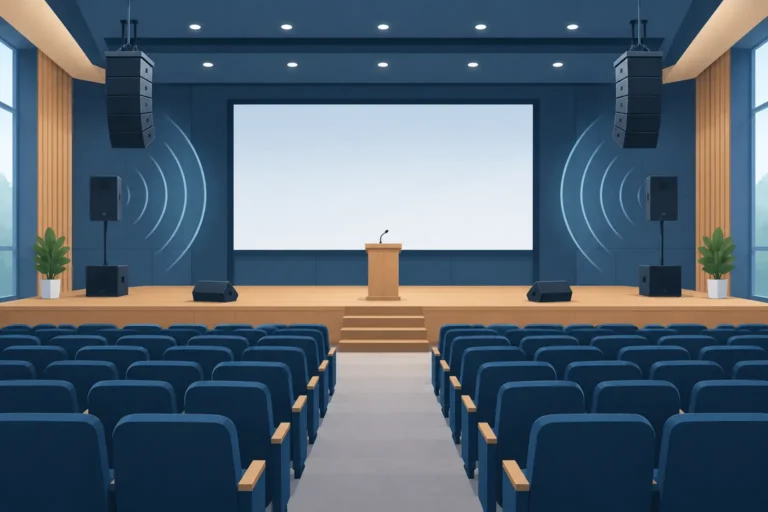
A speaker can have excellent content, a polished stage, and a full auditorium, yet lose the room within minutes if the back rows cannot understand every word. This auditorium sound system guide is designed for event teams planning conferences, corporate presentations, government forums, graduations, and live programs where clear communication is non-negotiable.
An auditorium audio system is not simply a pair of loudspeakers and wireless microphones. It is a coordinated design that must match the room, audience size, program format, stage layout, and level of production support required. When the system is specified correctly, speech feels natural across the room, presenters remain confident, and technical operation stays under control.
Start With the Room, Not the Equipment
The auditorium itself determines much of the system design. A flat-floor lecture hall, a steeply raked theater, a ballroom converted for a keynote, and a large multipurpose venue all distribute sound differently. Ceiling height, seating depth, wall finishes, stage position, balconies, glass surfaces, and HVAC noise can all affect intelligibility.
The first requirement is coverage. Every seat should receive consistent speech level and clarity without the front rows being uncomfortably loud. This usually calls for carefully positioned main loudspeakers, with front-fill speakers for seats close to the stage and delay speakers for long rooms or balcony areas. Delay speakers are time-aligned so listeners hear a coherent voice rather than an audible echo.
Reverberation is the second consideration. Hard surfaces can cause speech to linger, reducing definition between words. More volume is rarely the answer. The better approach may be directional loudspeakers, disciplined microphone technique, equalization, and a system tuned for speech rather than excessive bass or volume.
A site survey before the event gives the technical team the information needed to plan speaker placement, cable routes, power distribution, control position, and safe installation. For high-profile events, this preparation is more valuable than selecting equipment from a generic package list.
Auditorium Sound System Guide: Define the Program
The right system depends on what happens on stage. A single executive delivering a 30-minute address needs a different approach from a full-day conference with panel discussions, video playback, walk-on music, audience questions, and remote contributors.
For speech-led events, the priority is intelligibility. Professional wireless handheld microphones work well for hosts, audience Q&A, and presenters who prefer to hold a microphone. Wireless lavalier microphones provide a discreet option for keynote speakers, although they require careful placement and gain control. Headworn microphones are often the strongest choice for active presenters because the microphone remains close to the mouth as they move.
Panel sessions need enough microphones for every participant, not a plan that relies on speakers passing one handheld microphone between them. Gooseneck microphones at a conference table can deliver a formal, organized appearance, while wireless tabletop units offer more flexibility in changing layouts. For larger forums, dedicated conference discussion systems can add delegate management, chairman priority, voting, and interpretation channel selection.
Music, awards stings, walk-in tracks, and video playback place different demands on the system. A program with live music requires additional loudspeaker capability, monitor mixes, direct input boxes, stage microphones, and more detailed soundcheck time. It is sensible to separate these needs from the speech system during planning, even when both use the same main audio infrastructure.
Build the System Around Clear Signal Flow
A dependable audio system follows a simple but disciplined signal path: microphone or playback source, mixing console, processing, amplification where required, and loudspeakers. Each stage must be appropriate for the event and supported by tested backup options.
The mixing console is the control center. A digital console gives the audio engineer quick access to equalization, compression, routing, scene recalls, and separate mixes for recording, streaming, confidence monitors, and overflow rooms. Scene recall is particularly useful for multi-session conferences, where opening music, keynote microphones, panel discussions, and award segments may need different audio settings.
Wireless microphone coordination deserves specialist attention. Large hotels, convention centers, and city-center venues often have congested radio frequency environments. Using properly coordinated frequencies reduces the risk of dropouts and interference. Event teams should also confirm local licensing and operating requirements, particularly for larger wireless deployments and radio communications.
Redundancy should match the consequence of failure. For a board presentation, a spare handheld microphone may be sufficient. For an international summit or televised leadership address, the plan may include backup microphones, dual playback paths, spare receivers, redundant recording, and an engineer positioned at the console throughout the program.
Plan for the Audience Beyond the Main Room
The audience experience may extend beyond auditorium seating. Overflow spaces, registration areas, green rooms, press rooms, and remote viewers often need controlled access to the program audio. These outputs should be planned from the beginning, rather than added after the system has been installed.
An overflow room needs more than a loudspeaker feed. If it includes video, the audio and picture must remain synchronized. A delay of even a fraction of a second can make speech feel distracting. Recording and streaming also require a dedicated mix, because the mix that sounds right in the room is not always the mix that sounds right on a recording or webcast.
Multilingual events require another layer of design. Simultaneous interpretation systems allow attendees to listen to the floor language or their preferred interpretation channel through receivers and headsets. The auditorium audio system must provide clean feeds to interpreter consoles and maintain clear routing between presenters, interpreters, remote participants, and recording channels. This is where experienced technical planning prevents avoidable problems during live sessions.
Give the Audio Team Time to Tune and Test
Even excellent equipment cannot compensate for rushed setup. The crew needs time to install, line-check, tune loudspeaker coverage, coordinate wireless frequencies, test playback, and verify every microphone in its actual speaking position.
Soundcheck should include the people who will use the system whenever possible. A lavalier microphone sounds different on each presenter depending on voice level, clothing, and placement. Panelists should be asked to speak naturally into their microphones. Playback should be checked at realistic levels, including videos supplied by presenters shortly before the event.
The production schedule should also allow for a final walk-through from the audience perspective. An engineer can listen from the front, center, rear, and balcony seats to confirm that coverage is even and speech remains intelligible. This is also the right time to identify sightline issues, noisy equipment, or speaker positions that may affect branding and stage design.
Renting vs. Owning Auditorium Audio Equipment
For most event organizers, rental provides the most practical route to a current, correctly sized system. Buying equipment can make sense for a venue with a predictable calendar, permanent infrastructure, and trained in-house technicians. However, ownership also brings maintenance, storage, upgrades, frequency management, testing, and staffing responsibilities.
A rental package can be scaled to the actual event. A corporate town hall may need a compact speech system and four wireless microphones, while a regional conference may require distributed speakers, a digital console, interpretation feeds, recording, stage monitors, and dedicated audio engineers. The package should be based on the program and venue rather than an arbitrary equipment count.
DLC Events supports this approach with professional audio rental, conference technology, multilingual communication systems, and technical crews configured around the event brief. For organizers managing multiple suppliers, a coordinated technical partner can reduce handoffs between audio, conferencing, interpretation, video, and show communications teams.
Questions to Settle Before You Confirm the System
Before approving an auditorium audio plan, confirm the room capacity and seating layout, the number and type of presenters, expected panel formats, playback and video requirements, languages, recording or streaming needs, and available setup time. Also identify who has authority to make on-site program changes. A clear technical brief helps the production team prepare the right inventory and crew from the outset.
The best auditorium sound system is rarely the largest one. It is the one that lets every attendee hear the message clearly, gives every speaker confidence, and gives the event team a controlled response when the program changes. Start with the audience experience, then build the system around the room and the agenda.