A missed cue at a conference is rarely caused by a major technical failure. More often, a stage manager cannot reach the audiovisual operator through a concrete service corridor, or two departments are sharing a channel when a VIP arrival changes the schedule. Knowing how to choose event radios means planning for these operational moments, not simply counting handsets.
For conferences, exhibitions, corporate meetings, film shoots, and live productions, two-way radios give the working team a direct line of communication when mobile phones are too slow, too distracting, or unreliable inside a busy venue. The right package supports quick decisions without adding noise, confusion, or compliance risk.
Start With the Event Communication Plan
Before selecting a radio model, map who needs to speak to whom. A 40-person corporate seminar may need only a small operations group: event manager, venue contact, audiovisual lead, registration supervisor, and security coordinator. A multi-hall exhibition or international summit may require separate teams for production, floor management, logistics, security, exhibitors, catering, transport, and client representatives.
This determines the number of channels, talk groups, accessories, and spare units required. It also prevents a common problem: issuing radios to everyone without defining a communication structure. More radios do not automatically create better control. They can create an overloaded channel where urgent instructions are lost among routine requests.
Establish a primary operations channel and separate channels for departments that need independent conversations. Decide who can monitor multiple channels, who has authority to make show-critical calls, and which users need radio access only during setup, live operation, or strike. For high-profile programs, a designated communications lead can manage channel discipline and escalate issues without involving every department.
Match Coverage to the Venue, Not the Guest Count
Radio coverage is one of the most important factors when choosing event radios. The size of the audience is relevant, but the physical venue matters more. A ballroom in a hotel, a convention center with several halls, an outdoor activation, and a film location each create different signal conditions.
Concrete walls, metal structures, loading docks, basements, elevators, back-of-house corridors, and dense exhibition stands can weaken or block radio signals. A handset that performs well in an open outdoor area may not provide reliable communication between a production office and a ballroom stage two floors away.
Ask for a site assessment or, at minimum, provide the venue floor plans, room assignments, loading access, and operating locations to your technical provider. For larger or complex sites, coverage testing before doors open is worthwhile. The team should test radios from the stage, registration desk, control room, green room, loading bay, parking area, and any remote activity zones.
Power output alone is not the answer. Higher-power equipment may extend range in certain conditions, but venue structure, permitted frequencies, antenna design, and local regulations all affect performance. A professional solution balances coverage with legal operation and practical battery life.
Use Licensed Equipment and Approved Frequencies
In the UAE, event radio communications must operate within the applicable TDRA requirements. This is not a detail to leave until event day. Unlicensed or incorrectly programmed radios can interfere with other communications services and may create operational and compliance issues for the organizer and venue.
Work with a provider that supplies TDRA-licensed radio communications and manages the appropriate frequency planning for the event. This is especially relevant for major conferences, government programs, public events, exhibitions, and events with security-sensitive operations.
If an international production team is bringing its own equipment, confirm early whether those radios can be used locally and whether frequency authorization is required. In many cases, renting locally licensed equipment is the faster and more dependable option. It also avoids carrying devices that are incompatible with the venue plan or local frequency allocation.
Choose the Right Radio Type and Audio Setup
A standard handheld two-way radio suits many event roles, particularly operations, logistics, venue coordination, and technical crews. It is portable, quick to issue, and easy to operate after a short briefing. However, the best radio is not always the most suitable audio setup.
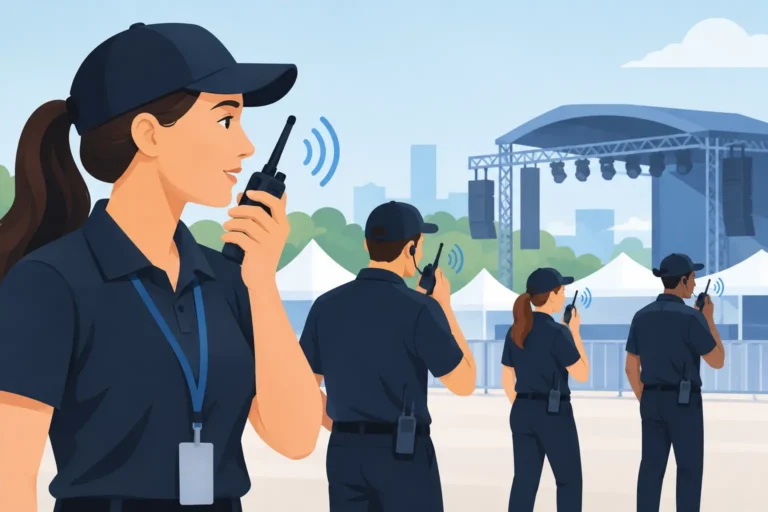
For floor managers, security teams, hosts, or personnel working near guests, an earpiece with a discreet push-to-talk microphone keeps communication private and professional. For show callers and production managers in a control position, a speaker microphone or surveillance-style earpiece can make long shifts more comfortable. Crew members working in noisy areas may benefit from headsets designed to improve speech clarity and reduce surrounding noise.
Consider the working environment carefully. A handheld radio with a loudspeaker may be acceptable during build-up, but it can be disruptive beside an executive speaker, during a gala dinner, or in a quiet conference session. Conversely, a very discreet earpiece may be impractical for a loader or technician who needs to hear people and equipment around them.
For productions where timing is critical, distinguish between two-way radios and dedicated show intercom systems. Radios are ideal for mobile operational coordination. Wired or wireless intercom is often the better choice for show calling, camera teams, lighting, audio, and video operators who need continuous, low-latency communication. Many events need both systems, each serving a different operational purpose.
Plan Channels for Real Departments
Channel planning should reflect how the event actually runs. A useful structure might separate event operations, audiovisual production, security, registration and guest services, and logistics. Not every team needs a private channel, but departments handling frequent or time-sensitive communication usually do.
Keep the plan simple enough for temporary staff and external suppliers to follow. Each radio should be clearly programmed, labeled, and issued with instructions on which channel to use. A channel card can help, but the best approach is a short in-person briefing before operations begin.
Radio etiquette also matters. Ask users to identify themselves, keep transmissions brief, wait for a channel to clear, and avoid broadcasting sensitive client information. Urgent traffic needs a clear process. Some teams use a designated phrase for immediate operational attention, while others reserve a channel for show-critical or security communication. The method should align with the event’s security plan and staff experience.
Do Not Underestimate Battery and Accessory Requirements
A radio package must cover the full operational day, not only the live session. A conference that opens at 9:00 a.m. may have staff on site from 6:00 a.m. through evening load-out. Exhibitions and multi-day summits often have even longer schedules.
Confirm expected battery duration under active use, then include charging arrangements, spare batteries, or replacement radios where needed. High-use teams such as floor management, technical operations, and logistics should not be left without communication during a battery change. For multi-day events, establish a clear overnight charging and inventory process.
Accessories should be selected by role, not added automatically. Belt clips work for many users, while secure earpieces, speaker microphones, heavy-duty headsets, and protective cases may be justified for specific departments. Labeling radios, batteries, and accessories by team reduces loss and speeds up collection after the event.
Build Redundancy Into High-Stakes Events
For a board meeting with a compact crew, a few spare radios may be sufficient. For an international congress, product launch, or event with multiple venues, redundancy should be part of the plan. This includes spare handsets, charged batteries, replacement earpieces, and a technician who can respond quickly if a device is damaged or incorrectly configured.
It also means considering what happens when the schedule changes. Can an extra logistics team be added at short notice? Can a secondary venue or outdoor zone be covered? Can a channel be reassigned without disrupting the show team? Rental packages are valuable because they can be scaled around the actual production plan rather than forcing every event into an owned inventory.
DLC Events provides licensed radio rental packages with technical setup and onsite support for events across Dubai, the UAE, and the wider GCC. For complex programs, the value is not only the equipment. It is the preparation behind it: venue-aware planning, programmed channels, properly matched accessories, and a support team ready to keep communications moving.
Questions to Ask Before You Confirm Your Radio Rental
A productive supplier conversation starts with the event schedule, venue plans, crew size, and department structure. You should also ask whether the equipment is locally licensed, how coverage will be assessed, how many channels are available, and what backup equipment is included.
Clarify delivery and collection times, particularly when the venue has restricted loading windows. Confirm whether the rental includes charging stations, earpieces, radio labeling, a communications briefing, and onsite technical support. For an event with security or government stakeholders, make sure radio planning is coordinated with the approved operational and security procedures.
The right event radios should disappear into the workflow: clear voices, defined channels, charged batteries, and immediate support when the plan changes. Choose a communications partner that understands the venue and the pressure points of live events, and your team can stay focused on the audience experience rather than chasing updates by phone.