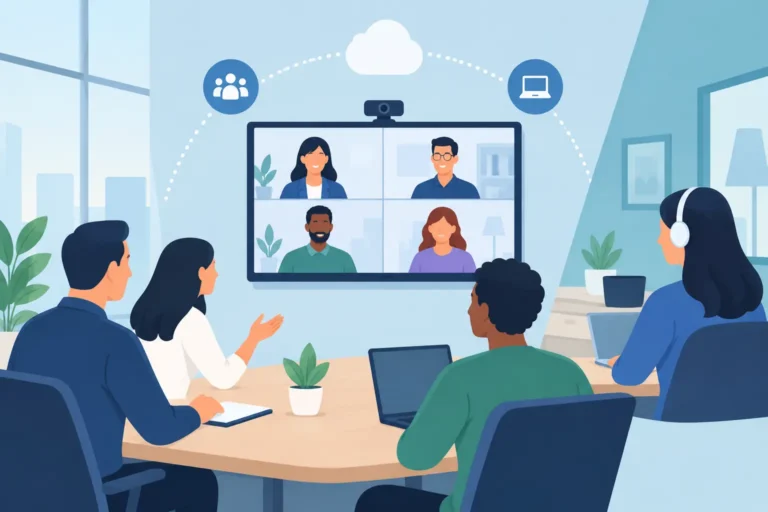
A keynote can lose authority in seconds when remote viewers cannot hear a question, a presentation feed reaches the stream late, or a multilingual audience has no clear audio path. This hybrid keynote production case study examines a representative executive event in which the in-room audience, virtual delegates, remote speakers, and interpreters all needed to operate as one program.
The brief was familiar to many conference producers: deliver a high-profile opening keynote from a Dubai venue, welcome an invited audience in the room, and extend access to international stakeholders joining online. The production requirement was not simply to add a camera and a streaming platform. It was to create a controlled communication environment where every audience received the right message, in the right language, at the right time.
The event brief: one keynote, several audiences
The program centered on a 45-minute leadership keynote followed by a moderated discussion and audience Q&A. Attendees in the ballroom included senior executives, partners, media representatives, and delegates requiring Arabic and English interpretation. Online participants joined from several time zones, while two panel contributors were scheduled to appear remotely.
The organizer needed the keynote to feel deliberate rather than divided between a room and a screen. Speakers required confidence monitors and teleprompter support. Remote viewers needed a broadcast-quality mix, not an audio feed captured from the back of the room. The moderator needed to hear remote contributors without creating feedback, and interpreters needed clean source audio that did not include room noise or competing program feeds.
This is where hybrid planning changes the production conversation. A conventional conference AV package can serve the room very well. A hybrid keynote requires separate consideration for the room experience, the broadcast experience, language distribution, speaker cueing, and the production team’s operational communications.
Hybrid keynote production case study: designing the signal flow
The technical design began with a simple principle: every audience path needed a defined source, mix, and backup. The main presentation was sent to the confidence monitor, stage display, and video switcher as separate controlled outputs. Camera feeds were managed through the switcher so the online audience could see a planned mix of wide stage shots, speaker close-ups, presentation content, and remote contributors.
For audio, the room PA and the online program mix were treated as different destinations. The ballroom audience needed natural speech reinforcement and clear playback. Virtual delegates needed a dedicated mix that prioritized the keynote microphone, remote panelists, presentation playback, and interpreter channels when selected. Building a separate program mix avoids a common hybrid failure: an online audience hearing only the room, with applause louder than the speaker and questions nearly impossible to understand.
The presenter used a wireless microphone selected and coordinated for the venue environment, with a backup microphone ready at stage side. A teleprompter supported the opening address, while a confidence monitor displayed presentation cues and remote participant returns. These tools reduced the need for speakers to turn away from the audience or rely on last-minute verbal prompting.
The video team also planned for content protection. Presentation files were tested at native resolution, playback clips were checked for audio routing, and a backup presentation computer was prepared. This is a practical safeguard, particularly when a keynote contains financial updates, launch material, or tightly timed leadership messaging.
Rehearsal exposed the issues that mattered
The most valuable part of this deployment happened before guests entered the venue. During technical rehearsal, the team tested not only whether each device worked, but whether the complete experience worked under live conditions.
Remote contributors joined from their own locations and were checked for framing, lighting, network stability, audio quality, and return video. One contributor’s laptop microphone created a noticeably thin sound compared with the podium presenter. The production team adjusted the audio processing and confirmed a headset alternative before the program began. That intervention protected the perceived quality of the panel without delaying the agenda.
The interpretation setup was tested with the actual keynote audio feed, presentation playback, and moderator microphone. Interpreters received the source they needed, while delegates used receivers and headsets assigned to the selected language channel. This matters because interpretation cannot be treated as an add-on after the main audio system has been configured. The interpreters need to hear every speaker, remote contribution, and video playback element clearly enough to deliver accurate real-time language support.
The rehearsal also confirmed cueing. The stage manager could communicate with the presenter, moderator, video director, audio engineer, and streaming operator through a show intercom system. Licensed two-way radios supported event-floor coordination where required. In the UAE, TDRA-licensed radio communications are particularly relevant for professional event operations and venue coordination.
Managing the Q&A without excluding remote delegates
Q&A is often the point where a hybrid program becomes uneven. An attendee in the room asks a question without a microphone, the moderator repeats only part of it, and remote delegates lose the context. The solution in this case was operational rather than complicated.
Floor microphones were positioned for in-room questions, and the moderator received a monitored feed of approved online questions. A producer grouped digital submissions by topic and relayed the strongest questions to the moderator at appropriate moments. Every spoken question entered the audio system, the interpretation workflow, and the stream mix.
This arrangement did not mean every online question was answered. It gave the moderator a controlled way to balance room participation with virtual engagement while keeping the keynote on schedule. For executive events, timing is often as important as interaction volume.
Contingency planning protected the live program
No hybrid event is free from risk. Venue internet capacity, remote participant connections, content changes, and last-minute speaker requests can all affect the show. The right response is not to promise that nothing will fail. It is to identify likely failure points and prepare sensible alternatives.
For this program, the production plan included redundant presentation playback, backup microphones, duplicate content files, local recording, and an alternate communication route for remote contributors. The stream was monitored from the audience perspective as well as from the technical side, allowing the team to identify issues in program audio, lip sync, graphics, and camera framing quickly.
Local recording was especially useful. It created an archive-quality version of the keynote that could be edited or shared after the event without relying solely on the streamed output. Depending on the organizer’s requirements, recordings can also support internal communications, training, investor updates, or regional distribution.
What the organizer gained from the production approach
The primary outcome was consistency. In-room guests experienced a polished keynote with clear sound, purposeful visuals, and professional speaker support. Online delegates received a directed program rather than a passive view of the ballroom. Multilingual attendees could follow the keynote in their preferred language, and remote contributors could participate without disrupting the room.
Just as significant, the organizer retained control. A managed technical production team coordinated equipment, setup, testing, live operation, troubleshooting, and strike. That reduced the burden on the event manager, who could focus on speakers, guest experience, approvals, and the wider program.
DLC Events approaches this type of requirement as a configurable rental and managed-production package. The final equipment selection depends on venue layout, delegate count, streaming platform, language requirements, visual branding, remote speaker locations, and the level of redundancy the event warrants.
Applying the case study to your next keynote
The lesson is not that every keynote needs the same equipment. A 100-person leadership meeting may need a compact camera package, a teleprompter, one remote guest connection, and two interpretation channels. A regional summit with several breakouts may require multiple camera positions, conference microphones, digital name signs, remote interpretation, recording, and dedicated technical crews across rooms.
Start by defining who needs to hear, see, speak, and interact. Then identify where each person will be: on stage, in the room, online, in an interpretation booth, or at a remote location. That information shapes the audio, video, communication, and staffing plan far more effectively than choosing equipment from a generic checklist.
A successful hybrid keynote is not measured by how much technology is visible. It is measured by whether every participant can follow the message with confidence, wherever they are seated.