A speaker can have the right message, a strong presentation, and a full room of engaged delegates, yet still lose the audience if the PA system is poorly planned. This PA system guide is designed for organizers who need reliable, intelligible sound for conferences, corporate meetings, exhibitions, launches, and live programs where every word matters.
A professional public-address system is not simply a collection of speakers and microphones. It is a coordinated audio solution built around the room, audience size, program format, speaker requirements, and the need for clear coverage from the front row to the back of the venue. The right system supports the event. The wrong one becomes the event.
PA System Guide: Start With the Event, Not the Equipment
The first question is not, “How many speakers do we need?” It is, “What must the audience hear, where, and under what conditions?” A boardroom presentation, a ballroom awards ceremony, and an outdoor product launch can all require professional PA equipment, but the technical approach will be very different.
For a corporate conference, speech intelligibility is usually the priority. Delegates need to hear panelists, moderators, presentation videos, and audience questions without strain. For a gala or launch, the system may also need to reproduce music with impact while maintaining clear announcements. An exhibition stand often needs controlled sound coverage that attracts visitors without spilling excessively into neighboring stands.
Program complexity also affects the design. A single keynote using one lectern microphone is straightforward. A multi-session summit with panel discussions, walk-on music, remote contributors, playback videos, press feeds, and simultaneous interpretation requires greater routing, monitoring, redundancy, and on-site control.
This is why equipment selection should follow an event brief and venue assessment. A capable technical partner will ask about room dimensions, ceiling height, seating layout, stage location, audience numbers, event schedule, content sources, and any venue noise restrictions before confirming a system package.
What a Professional PA System Includes
Most event PA systems contain more than loudspeakers. Each component has a specific function, and the value comes from how they work together.
Microphones capture speech and performance audio. The appropriate type depends on the presenter and format. Gooseneck microphones work well at lecterns and conference tables. Wireless handheld microphones are useful for audience Q&A, awards, and roaming presenters. Lavalier and headset microphones allow speakers to move freely, although they require careful placement and frequency coordination.
The audio mixer is the operating center of the system. It receives microphones, laptops, video playback, music sources, interpretation feeds, and remote-call audio, then balances them for the room and recording or streaming outputs. For higher-stakes programs, a trained audio engineer should manage levels throughout the event rather than relying on a fixed setup.
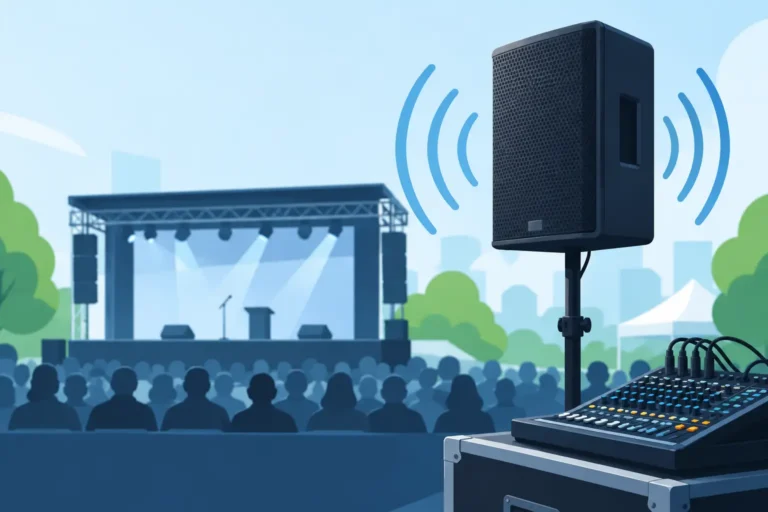
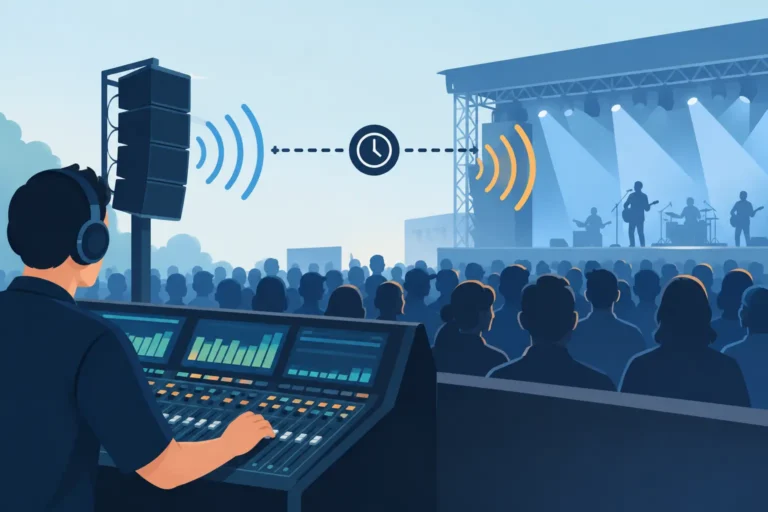
Loudspeakers distribute sound to the audience. Main speakers cover the primary seating area, while front-fill speakers may support guests seated close to the stage. Delay speakers can be required in long ballrooms, wide exhibition spaces, or overflow areas so guests farther from the stage hear synchronized audio at an appropriate level. Subwoofers may be added for music-led programs, but they are not always necessary for a speech-focused conference.
Signal processing, amplifiers, stands or rigging, cable management, power distribution, and backup equipment complete the system. These details are less visible to attendees, but they are often what separate a controlled production from a setup that is vulnerable to noise, feedback, interruptions, or uneven sound.
Match Coverage to the Room
A common planning mistake is specifying a PA system based only on attendee count. Audience size matters, but the venue shape and acoustic behavior matter just as much.
A compact meeting room with 80 attendees may need only a discreet speaker pair and several conference microphones. A 300-person ballroom with a wide seating plan may require distributed coverage to ensure that guests at the sides receive the same clarity as those in the center. In a large hall, placing louder speakers at the front is rarely the answer. Excessive volume can make the front rows uncomfortable while leaving the rear of the room unclear.
Hard surfaces such as glass, marble, and concrete reflect sound. High ceilings can increase reverberation. These conditions make speech less distinct, especially when presenters speak quickly or when attendees are listening in a second language. Proper speaker positioning, directional loudspeakers, appropriate microphone technique, and digital audio processing help manage these challenges.
Outdoor events bring different variables: wind, ambient traffic, generator noise, open-air sound dispersion, weather protection, and distance between the stage and audience. The system must be designed for the site, not borrowed from an indoor meeting-room specification.
Choose Microphones for How People Will Speak
Microphone choice has a direct effect on audience experience. It also shapes how easily the production team can manage feedback, clothing noise, handling noise, and transitions between speakers.
A lectern microphone is suitable when the speaker remains in one location. For executive presentations, a discreet lavalier microphone can create a more natural stage presence, provided the presenter is comfortable wearing it and the system is professionally tuned. A headset microphone is often the stronger choice for trainers, fitness demonstrations, or presenters who move frequently because it remains close to the mouth and delivers more consistent level.
Panel discussions need particular attention. Individual tabletop microphones provide the best control and sound quality for formal sessions. Sharing a handheld microphone may reduce equipment requirements, but it slows the conversation and creates uneven levels. For high-profile conferences, dedicated conference discussion systems can offer delegate microphones, chairman control, speaker management, and integration with interpretation channels.
Wireless microphones require coordinated radio frequencies, especially in hotels, convention centers, and dense urban locations. This is not an area to leave to last-minute setup. Licensed and properly coordinated radio communications protect reliability when multiple wireless systems are operating nearby.
Plan for Audio Beyond the Main Room
Many events require sound in more than one place. Registration areas may need background music and announcements. Breakout rooms may need independent presentation audio. A media room may need a clean press feed. Overflow spaces may need live program audio and video. Hybrid events often need separate audio feeds for remote attendees, recordings, and streaming platforms.
These outputs should be planned from the beginning. A room mix that sounds right to delegates is not automatically right for a webcast. Remote audiences may need a dedicated mix with stronger presenter microphones, controlled playback levels, and echo-free audio from online contributors.
For multilingual conferences, the PA system must also coordinate with simultaneous interpretation. Floor audio from speakers and panelists is routed to interpreters, while delegates receive the selected language through receivers or digital channels. Clear source audio is essential. If interpreters cannot hear the floor properly, every language channel is affected.
Why an Audio Engineer Matters During Live Programs
Modern equipment can be powerful, but equipment alone does not manage a live event. An experienced audio engineer monitors microphone levels, prevents feedback, cues walk-on music, manages video playback audio, supports presenter changes, and responds quickly if a cable, battery, or source fails.
This is especially valuable when the agenda changes in real time. A moderator may invite an unplanned audience question. A panelist may arrive with a video on a personal laptop. A remote speaker may need to join from another time zone. With an operator at the console, these changes can be handled without distracting the audience.
For major conferences and multi-room programs, technical staffing should be scaled alongside the equipment package. One technician may be suitable for a simple meeting. A summit with multiple rooms, interpretation, recording, and broadcast requirements needs a larger, clearly assigned crew.
Renting a PA System for Professional Events
Renting gives event teams access to current professional audio inventory without ownership costs, storage requirements, maintenance schedules, or the need to retain specialist engineers internally. It also allows the system to scale with each event. The audio package for a 40-person training session should not be the same as the package for a 1,000-person regional conference.
A managed rental solution should include technical consultation, delivery, installation, testing, operation where required, and post-event removal. Ask whether the provider has assessed the venue, allowed time for sound checks, coordinated with the venue team, and included contingency equipment for mission-critical program elements.
At DLC Events, PA rental can be configured alongside conference microphones, interpretation systems, teleprompters, recording, show intercom, and wireless communications. This integrated approach reduces handoffs between suppliers and gives organizers clearer technical accountability across the event.
A Better Brief Produces Better Audio
When requesting a PA system quotation, provide the event date, venue, room layout, attendee count, stage plan, agenda, microphone requirements, video and music sources, recording or streaming needs, language requirements, and available setup time. Include any known venue restrictions, such as rigging limits, curfews, or rules on wireless frequencies.
The more complete the brief, the more accurately the technical team can specify equipment and crew. There is no benefit in overbuilding a simple program, but under-specifying sound for a high-stakes event can affect speaker confidence, audience engagement, and the perceived quality of the entire production.
Clear audio is one of the fastest ways to make an event feel organized, credible, and easy to follow. Build the PA plan around the people in the room, the content on the agenda, and the conditions of the venue, then give the technical team enough information to deliver it properly.