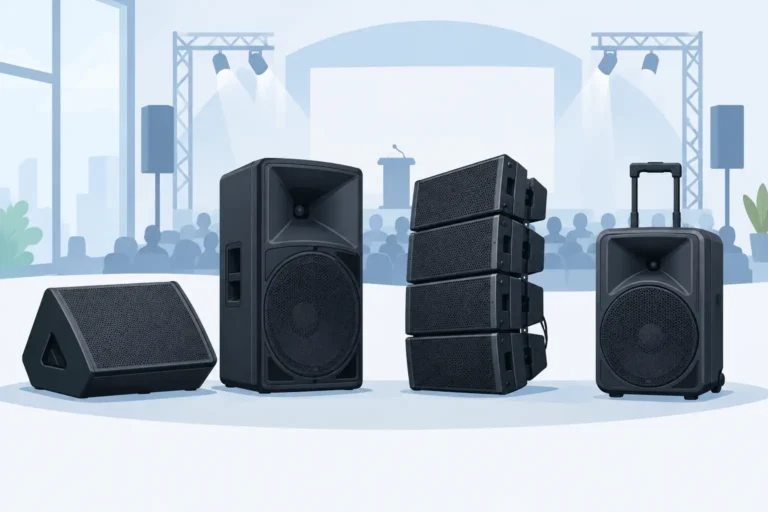
A keynote can look polished on stage and still lose the room if guests at the back hear a weak, echoing version of every sentence. A proper PA speakers comparison starts with that event reality: the right system is not simply the loudest option. It must deliver clear, even speech and music coverage to every listener, while fitting the venue, program, audience size, and production schedule.
For conferences, exhibitions, corporate meetings, and live events, PA selection is a system decision. Speakers, amplifiers, processors, microphones, placement, cabling, and an experienced technical crew all affect the result. The most suitable package depends on what the audience needs to hear and where they are seated.
PA Speakers Comparison: Start With Coverage, Not Wattage
Wattage is often the first specification organizers see, but it is rarely the best starting point. A higher power rating does not automatically mean a speaker will sound clearer, travel farther, or work better in a difficult room. Speaker efficiency, cabinet design, dispersion pattern, system tuning, and placement have just as much influence.
For a boardroom presentation, the priority is intelligible speech at a comfortable level. A compact professional speaker system may be more appropriate than a large-format PA, especially where the audience is close to the presenter. Oversizing the system can create reflections, feedback risk, and an uncomfortable listening experience.
A ballroom keynote is different. Wide seating, high ceilings, and hard surfaces can make the front rows sound very different from the rear. This environment may require left and right main speakers, carefully positioned delay speakers, and digital signal processing to maintain consistent level and clarity across the room.
Outdoor events introduce another set of variables. There are fewer reflective surfaces, but wind, crowd noise, distance, and environmental restrictions affect design choices. A system that performs well indoors may not provide enough controlled coverage for an outdoor product launch or festival activation.
The relevant question is not, “How many watts do we need?” It is, “How can every attendee hear the program clearly without excessive volume?”
Main PA Formats and Their Best Uses
Point-source speakers
Point-source speakers project sound from a single cabinet or closely grouped cabinets. They are widely used for meeting rooms, breakout spaces, small stages, exhibitions, and corporate functions. Their strength is flexibility: they can be deployed on stands, flown where the venue permits, or used as front-fill and delay coverage within a larger system.
For speech-led events, quality point-source speakers can provide excellent vocal clarity and natural sound. They are also efficient for rooms with modest audience sizes or irregular layouts. The trade-off is that a large or deep room may need multiple cabinets and careful alignment to avoid hot spots near the stage and low volume at the back.
Line array systems
Line array systems use vertically arranged speaker elements to control sound over longer distances. They are commonly selected for larger conferences, award ceremonies, concerts, arena-scale programs, and outdoor events where audience areas extend far from the stage.
The principal benefit is controlled, predictable coverage. A properly designed line array can project sound to distant seating while limiting unwanted energy on ceilings or rear walls. This helps improve intelligibility in challenging venues.
However, line arrays are not automatically the right choice for every event. They need appropriate rigging, height, space, processing, and technical design. Using a line array in a small, low-ceiling room can be unnecessary and may complicate the production without improving the audience experience.
Column speakers
Column speaker systems offer a discreet profile and broad horizontal coverage. They work well for executive presentations, hospitality areas, panel discussions, galleries, retail activations, and small-to-medium corporate rooms where appearance matters alongside performance.
Because they are visually less intrusive than conventional speaker stacks, column systems can support a clean stage design. They are best suited to controlled speech and moderate music playback rather than high-output entertainment programs requiring deep bass and concert-level impact.
Subwoofers and full-range systems
Full-range speakers reproduce speech and much of the music spectrum on their own. For presentations, training sessions, and panel discussions, this may be all that is required. Adding subwoofers extends low-frequency response for walk-in music, video playback, DJ sets, live bands, and high-impact product launches.
Subwoofers should be selected with purpose. They bring weight and energy to music, but too much low-frequency output can overwhelm speech, create noise transfer to adjacent rooms, or conflict with venue restrictions. In a conference setting, clean and controlled audio is usually more valuable than excessive bass.
Active vs. Passive PA Speakers
Active speakers have built-in amplification, while passive speakers require separate external amplifiers. Both formats can be used professionally, but their operational roles differ.
Active systems can be quick to deploy for smaller events because amplification and processing are integrated into the speaker cabinet. They are useful for breakouts, mobile presentations, temporary exhibition spaces, and straightforward corporate programs. Their limitation is that power and signal distribution must be planned at every speaker location.
Passive systems are frequently used in larger engineered installations and premium touring-style systems. Centralized amplification and system processing can offer more control, particularly for complex multi-speaker deployments. They typically require more infrastructure, which is why they are best specified and operated by an experienced audio team.
For an organizer, the practical distinction is less about ownership of a particular format and more about reliable delivery. The right rental package should include the required amplification, processing, cabling, stands or rigging, power distribution, and support personnel.
Venue Acoustics Can Change the Entire Specification
A PA system is only as effective as its interaction with the room. Glass, marble, exposed concrete, high ceilings, and open exhibition halls all reflect sound. These reflections can blur consonants and make a speaker seem loud without making them understandable.
In these venues, directional speaker selection and accurate placement matter. Bringing speakers closer to listeners through distributed audio or delay speakers can often improve clarity more effectively than increasing volume from the stage. Each delay position must be time-aligned so the audience perceives a single coherent sound source rather than an audible echo.
Partitioned ballrooms require special attention. A room may operate as one general session in the morning and divide into several breakout rooms later in the day. The audio design should account for isolation, independent program feeds, microphone quantities, and the possibility of sound traveling through movable walls.
For multilingual conferences, the PA system also works alongside simultaneous interpretation equipment. Delegates need clear floor audio in the room, while interpreters need reliable feeds from microphones, video playback, and remote contributors. Audio routing must be designed as one coordinated communications system, not as separate equipment categories.
Speech, Music, and Hybrid Events Need Different Priorities
Speech intelligibility is the primary requirement for most corporate events. This means selecting speakers with clear vocal reproduction, placing them correctly, and using professional microphones that suit the presenter format. A handheld wireless microphone, lectern microphone, headset, or panel gooseneck microphone has different gain and feedback characteristics.
Music-heavy programs demand wider frequency response, higher output capability, and usually subwoofers. Live bands and DJs also need stage monitoring so performers can hear themselves without competing with the main audience system.
Hybrid events add another layer. Remote viewers require a clean audio feed that is independently mixed for streaming or recording. The room mix should not simply be sent to the online platform because audience reactions, playback levels, and room acoustics can produce an unbalanced result. A dedicated broadcast mix helps remote participants hear presenters, interpreters, videos, and questions clearly.
Why Professional Setup Matters as Much as the Equipment
A speaker rental list does not show the most critical parts of event audio: system design, tuning, sound checks, show operation, and contingency planning. A professional technician assesses the room, sets appropriate levels, manages wireless frequencies, monitors for feedback, and responds quickly if the agenda changes.
This becomes particularly valuable when an event includes multiple rooms, VIP speakers, live video, conference microphones, interpretation channels, or strict access windows. The crew needs to coordinate with venue teams, stage management, lighting, video, and event organizers before doors open.
DLC Events provides configurable professional audio rental packages supported by technical setup, operation, and troubleshooting for events in Dubai, the UAE, across the GCC, and internationally. The objective is not to supply more speakers than necessary. It is to deliver controlled, reliable sound that supports the agenda and reflects the standard of the event.
When planning your next program, share the venue plan, attendee count, room layout, content format, and any multilingual or hybrid requirements early. Those details turn a PA speakers comparison from a product exercise into an audio design that lets every message reach the room with confidence.