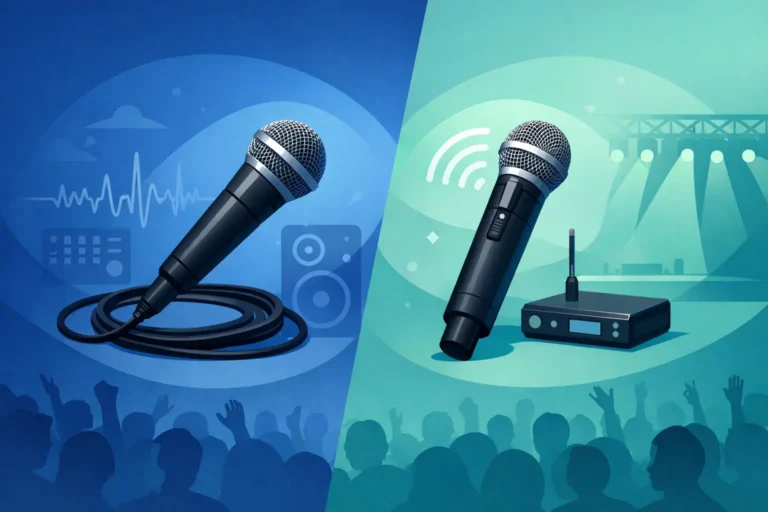
A keynote speaker steps onto a conference stage, a panelist needs to pass a microphone across the table, and a moderator must keep the program moving. The decision between wired versus wireless microphones affects far more than how a microphone looks. It influences speech clarity, stage movement, room setup, backup planning, and the workload on the technical team.
For corporate meetings, government forums, exhibitions, and international conferences, there is no single correct choice. A fixed lectern presentation has different requirements from a high-energy product launch or a multilingual summit with several breakout rooms. The right system is the one that supports the format, venue, audience, and production plan without creating unnecessary operational risk.
Wired Versus Wireless Microphones: The Core Difference
A wired microphone connects directly to an audio mixer, conference system, or sound system through a physical cable. The signal path is straightforward, dependable, and generally unaffected by radio-frequency congestion. Wired options include handheld microphones, gooseneck microphones for conference tables, lectern microphones, and boundary microphones for selected meeting applications.
A wireless microphone transmits audio by radio signal from a handheld transmitter, bodypack, or headset to a receiver connected to the sound system. It gives speakers freedom to move without a cable underfoot. This makes it a strong choice for presenters walking a stage, performers, roving moderators, audience Q&A, and event formats where the room layout changes throughout the day.
The practical distinction is simple: wired systems prioritize fixed-position reliability, while wireless systems prioritize mobility. Professional event production often uses both at the same event.
When Wired Microphones Are the Better Choice
Wired microphones are particularly effective when speakers remain in a defined position. A CEO delivering remarks from a lectern, a formal board meeting, or a seated discussion conference can benefit from the consistency of a wired setup. There are no batteries to change and no wireless channels to coordinate.
For long sessions, wired tabletop delegate units and gooseneck microphones also provide an orderly, professional conference environment. Each participant has a clear speaking position, and the system can be configured for chairman priority, request-to-speak functions, timed interventions, or integration with interpretation and conference management platforms.
Wired systems can also simplify audio planning in radio-sensitive locations. Large hotels, exhibition centers, broadcast environments, and venues hosting several events at once may have a crowded wireless spectrum. Using wired microphones where mobility is not needed preserves wireless channels for presenters and production roles that genuinely require them.
The trade-off is visible infrastructure. Cables must be routed safely, securely taped or covered, and planned around stage entrances, aisles, furniture, and camera positions. In a clean, minimal stage design, cable management is not an afterthought. It is part of the production design.
Best uses for wired systems
Wired microphones are commonly selected for lecterns, fixed panel positions, conference tables, interpretation booths, press briefing desks, and permanent or semi-permanent event stations. They are also a sound choice for events with extended operating hours where simple, predictable operation is the priority.
When Wireless Microphones Add Real Value
Wireless microphones are built for movement. A presenter can walk between screens, engage different sections of the audience, or demonstrate a product without being restricted to one point on stage. A fitness instructor, awards host, exhibition demonstrator, or master of ceremonies can work naturally while remaining clearly heard.
For most corporate presenters, a wireless lavalier microphone is discreet and practical. It keeps both hands free for notes, product handling, and natural gestures. A headset microphone can offer even more consistent voice pickup when a speaker moves rapidly or turns away from the main sound system. Wireless handheld microphones remain useful for Q&A, interviews, awards presentations, and any moment when a microphone needs to move quickly between people.
The benefit comes with additional planning. Every wireless channel requires frequency coordination, receiver configuration, battery management, signal monitoring, and a clear understanding of the venue environment. In the UAE and across the GCC, radio equipment must also be deployed in line with applicable licensing and regulatory requirements. This is one reason experienced technical crews are valuable on high-profile programs.
Wireless does not mean unreliable. Properly specified professional systems, coordinated frequencies, suitable antenna placement, fresh or rechargeable battery management, and active monitoring deliver dependable results. The issue is not whether wireless is good enough. The issue is whether the system has been designed and operated for the event rather than treated as a simple plug-and-play accessory.
Audio Quality Depends on More Than the Connection Type
It is easy to assume wired microphones automatically sound better than wireless models. In professional event environments, the more meaningful factors are microphone placement, capsule type, gain structure, speaker technique, room acoustics, and system tuning.
A well-positioned wireless headset can produce clearer speech than a wired lectern microphone placed too far from a speaker. Likewise, a wired gooseneck microphone at each panel position can provide more consistent results than a single wireless handheld passed between several people.
The microphone type should match the speaker and purpose. A lavalier works well for a keynote but may be unsuitable for a panelist who repeatedly turns toward other speakers. A handheld provides control and flexibility but depends on the user holding it at the correct distance. For formal conferences, a purpose-designed discussion microphone system can make every contribution audible while maintaining an organized tabletop layout.
Plan for the Venue, Not Just the Stage
The room often determines the best microphone strategy. A ballroom with a large stage, LED wall, confidence monitors, cameras, and walk-on music needs a different design from a boardroom, exhibition stand, or outdoor activation.
In a large room, wireless coverage must extend across every intended presentation area. Antenna locations, stage structures, LED walls, and backstage routes can affect performance. For hybrid events, microphone feeds may also need to serve the room sound system, recording devices, livestream platforms, remote speakers, and interpretation channels at the same time.
For a panel discussion, consider the seating arrangement and how often participants will speak. If the panel remains seated, wired goosenecks or a conference discussion system can create a cleaner result than multiple lavaliers. If panelists will move on and off stage, wireless lavaliers or handhelds may be more practical.
For audience participation, a combination approach is often strongest: fixed wired microphones for the stage, paired with wireless handhelds for roaming Q&A. This protects the core program while giving the moderator flexibility to involve attendees.
Reliability Is a System Design Question
A professional microphone plan includes redundancy. For a keynote, that may mean a primary wireless lavalier, a backup wireless handheld at the lectern, and a wired lectern microphone ready for immediate use. For a conference table, it may mean spare delegate units, additional cables, and a technician monitoring the discussion system.
Battery planning is equally important for wireless systems. Batteries should be checked and replaced according to the event schedule, not only when a low-battery warning appears. Rechargeable systems can be highly effective when chargers, battery inventory, and changeover timing are managed correctly.
Technical support also matters when the agenda changes. A last-minute speaker, a relocated panel, an unexpected Q&A, or an additional breakout room can alter microphone requirements quickly. Rental equipment supported by an experienced team gives organizers the ability to scale, reconfigure, and troubleshoot without placing those responsibilities on internal staff.
Choosing the Right Mix for Your Event
Most successful events do not choose wired or wireless exclusively. They assign each solution where it delivers the best outcome. Use wired microphones for fixed, high-priority positions and wireless microphones where mobility improves the presentation or audience experience.
A typical conference may use wired lectern and panel microphones, wireless lavaliers for keynote speakers, wireless handhelds for moderators and Q&A, and a conference discussion system for executive or delegate sessions. If simultaneous interpretation is required, the microphone system should be planned alongside interpreter consoles, language distribution, and participant headsets from the beginning.
DLC Events designs microphone packages around the program flow, venue layout, number of speakers, language requirements, and production objectives. That approach helps ensure equipment choices support the event rather than forcing the event to adapt to the equipment.
Start With How People Will Speak
Before selecting a microphone, map the moments that matter: who speaks, where they stand or sit, how they move, how long they speak, and where the audio must go. A wired system may be the most reliable answer for a fixed conference setting. A wireless system may be essential when movement is part of the presentation.
The best result is not the most complicated microphone package. It is a well-planned system that keeps every speaker clear, every transition controlled, and every audience member connected to the conversation.