A missed cue at a live event is rarely caused by the cue itself. More often, the message never reaches the right person: the loading dock is outside coverage, a channel is crowded, a battery has failed, or an untrained user is speaking over critical traffic. This event radio review focuses on what organizers and production teams should assess before selecting two-way radio equipment for conferences, exhibitions, summits, and live productions.
For event operations, a radio is not simply a handheld device. It is part of the command structure that connects registration, stage management, security, audiovisual teams, venue operations, logistics, and client representatives when timing matters. The right rental package should match the venue, crew size, operating environment, and communications plan rather than rely on a one-size-fits-all radio count.
Event Radio Review: The Criteria That Matter
Consumer-style reviews often focus on maximum advertised range, compact design, or the number of channels available. Those details have some value, but they do not establish whether a radio system will perform under live-event pressure. A reliable review starts with the actual communication path: who needs to speak to whom, where they will be positioned, and what can interrupt the signal.
Coverage is the first test. A ballroom, exhibition hall, hotel conference floor, outdoor activation, and multi-venue summit each present different obstacles. Concrete walls, service corridors, elevator cores, steel structures, underground parking, and dense exhibition stands can weaken or block radio signals. A radio that works across an open venue floor may not reach a technician backstage or a runner at a remote entrance.
The second consideration is channel planning. A small corporate meeting may operate effectively with one general channel and a separate technical channel. A large exhibition or international conference normally needs clearer separation between operations, production, security, registration, transport, and management. Without defined channels and radio discipline, essential calls become buried in routine traffic.
Audio intelligibility is equally important. Event teams work near loud PA systems, construction activity, crowds, generators, and catering operations. Professional radios with appropriate earpieces, speaker microphones, and noise-reduction features help users hear and respond without repeatedly asking for a message to be repeated. The result is faster decisions and a more controlled event environment.
Coverage Should Be Tested, Not Assumed
Range claims can be misleading because manufacturers often state them under ideal open-air conditions. At an event, usable coverage depends on building materials, antenna position, local radio activity, weather for outdoor sites, and whether the system is operating indoors, across a campus, or between separate venues.
For a single meeting room, compact licensed radios may be sufficient. For a hotel-wide conference, a convention center, or an outdoor festival footprint, the requirement can change significantly. Additional infrastructure, programmed channels, repeaters, or a different communications approach may be needed to maintain reliable contact in difficult areas.
A proper site assessment considers more than the main guest space. Technical teams should account for loading bays, back-of-house corridors, speaker holding rooms, control rooms, registration areas, parking zones, kitchens, storage spaces, and external access points. These are often the locations where operations are most active and where coverage gaps create avoidable delays.
For high-profile programs, the radio plan should also identify communications contingencies. If a primary channel becomes congested or a venue area presents weak reception, the team needs a known alternative before doors open. This does not need to make the operation complicated. It needs to make it predictable.
Licensed Frequencies Protect Operational Control
Radio communications are regulated, and professional event teams should not treat frequency use as an afterthought. In the UAE, radio equipment and operating frequencies must comply with applicable TDRA requirements. Using properly licensed radio communications helps reduce the risk of interference and supports a more dependable operating environment.
This is especially relevant in busy venues and city-center locations where multiple events, hospitality operations, broadcasters, security teams, and neighboring businesses may be using wireless systems at the same time. An uncoordinated radio setup can lead to interference, inconsistent audio, or disruption at the moment a crew needs clear direction.
Licensed equipment also gives organizers greater confidence that the communication plan has been considered as part of the wider technical deployment. For international producers arriving with their own equipment, local frequency coordination is a practical reason to work with an experienced regional provider rather than assume equipment configured elsewhere can be deployed without adjustment.
The Radio Must Suit the User and the Job
The best radio is not always the smallest or the most feature-heavy model. It should be easy for the assigned user to operate correctly while moving through their shift. A floor manager needs fast access to the right channel. A stage manager may need a discreet earpiece in a quiet speaker area. A security or logistics team may require a more durable unit and a speaker microphone that can be used while walking or working outdoors.
Accessories are part of the review, not an optional extra. Acoustic-tube earpieces support discreet communication for front-of-house teams and VIP areas. Remote speaker microphones can be more practical for crew members wearing uniforms, high-visibility clothing, or production belts. Multi-unit chargers, spare batteries, labeled cases, and hygienic individual earpieces all improve handover and reduce confusion during setup.
Battery planning deserves particular attention. A radio may be rated for a long operating period, but the real result depends on transmit time, audio volume, accessories, age of the battery, and the length of the event day. A short awards program and a 14-hour exhibition day should not be supported in the same way. For long schedules, spare batteries or managed charging rotations protect continuity.
Two-Way Radios and Show Intercom Serve Different Purposes
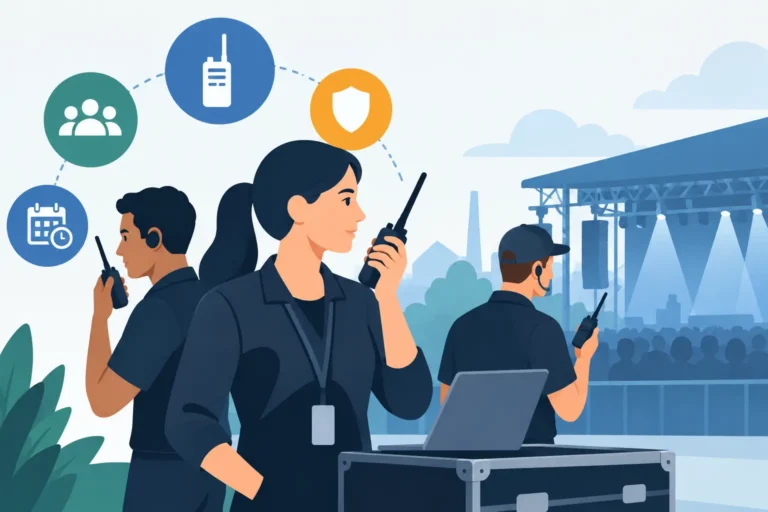
Two-way radios are ideal for mobile operational communication. They allow teams across a venue to coordinate arrivals, room turns, queue management, catering timing, speaker movement, technical requests, and incident response. Their flexibility makes them a core tool for most events.
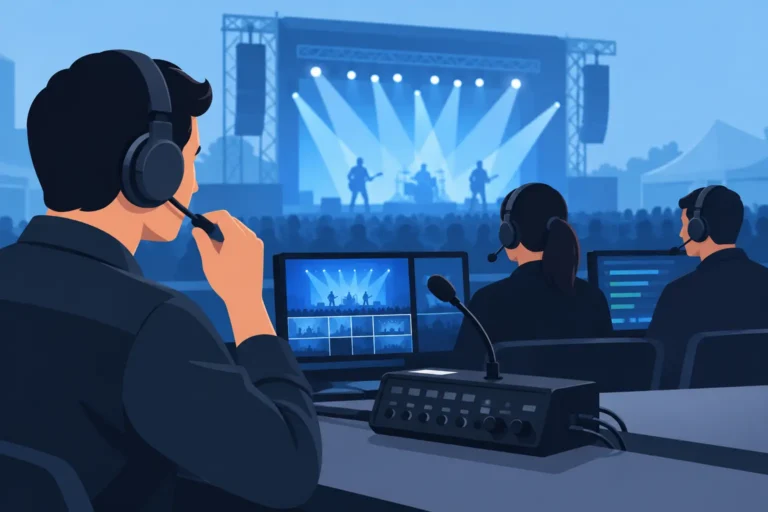
Show intercom systems serve a more specialized role. They are designed for production positions that require continuous, immediate communication, such as stage management, lighting, audio, video, camera, and show calling. In a live show environment, an open or managed intercom path can be more suitable than a push-to-talk radio channel.
Many complex events need both. The production team may use show intercom at the control position and backstage, while venue operations, registration, security, and logistics use two-way radios. Keeping these functions distinct prevents routine operational traffic from interrupting show-critical calls.
Rental Support Is Part of the Equipment Decision
Buying radios can appear economical for organizations that run frequent programs, but ownership brings storage, charging, programming, licensing, maintenance, battery replacement, cleaning, and inventory responsibilities. It can also leave a team short of units when an event expands beyond its normal footprint.
Rental provides flexibility. The equipment count can increase for a major summit, exhibition, or multi-room conference and reduce again for a smaller internal meeting. Packages can include the appropriate radios, batteries, chargers, earpieces, speaker microphones, carrying solutions, delivery, setup, and technical assistance.
The level of support should reflect the risk of the event. A straightforward business meeting may only require delivered and programmed equipment with a clear channel sheet. A complex production may benefit from on-site technical coordination, radio distribution, user briefings, coverage checks, and immediate replacement equipment if an issue occurs.
DLC Events supplies TDRA-licensed two-way radio solutions as part of tailored event technology packages across Dubai, the UAE, and the wider GCC. This approach is particularly valuable when radio communications must work alongside conference microphones, interpretation systems, audiovisual control, and a larger managed production setup.
What a Practical Radio Plan Looks Like
A useful radio plan is clear enough that a new crew member can follow it during a busy call time. It identifies the assigned channels, the teams permitted on each channel, the communication lead, the call-sign approach, and the procedure for urgent issues. It should also establish basic radio etiquette: keep messages brief, identify the intended recipient, confirm critical instructions, and move extended discussions off the main operational channel.
Organizers should avoid giving every attendee-facing staff member unrestricted access to the same channel. A busy channel becomes less useful when routine questions, test calls, and nonessential conversation prevent the production or operations lead from being heard. Separate groups where necessary, but do not overcomplicate the structure. The number of channels should reflect the number of genuinely independent workflows.
Before the event opens, conduct a radio check from representative locations and confirm that every user understands the channel assignment, volume control, push-to-talk function, and accessory connection. Five focused minutes during briefing can prevent hours of avoidable friction later.
The strongest radio setup is the one your team barely notices because it works when needed. Start with the event workflow, validate coverage in the actual venue, use compliant professional equipment, and assign support appropriate to the program’s complexity. Clear communication behind the scenes is what allows the guest experience to feel effortless.