A multilingual conference can lose its audience in seconds if translation arrives late, audio is unclear, or participants cannot access the right language channel. This live translation tools review is designed for event planners who need to choose a system that works under real production conditions, not just in a software demonstration.
For corporate meetings, government forums, international summits, and hybrid events, the right choice depends on language complexity, audience size, room layout, program format, and the consequence of an error. AI translation, remote interpretation, and on-site simultaneous interpretation can all deliver value. They do not solve the same problem.
What Live Translation Tools Must Deliver at Events
Live translation is often discussed as a single category, but an event system has several connected parts: speech capture, language processing or interpretation, distribution to attendees, and technical monitoring. A weakness at any point affects the audience experience.
The first requirement is intelligibility. Speakers need properly positioned microphones, interpreters need a clean audio feed, and attendees need reliable headphones or a mobile audio channel. Translation quality cannot compensate for poor source audio, room noise, or an overloaded wireless network.
The second is latency. A short delay is expected with simultaneous interpretation and AI speech translation. But when delay becomes noticeable, panel discussions feel disconnected, audience questions become difficult to manage, and virtual attendees may hear translated content after the presentation has moved on.
The third is operational control. Producers need to know who is speaking, which languages are active, whether receivers are charged and assigned, and who can resolve a fault without interrupting the session. For high-stakes events, this is as important as the translation engine itself.
Live Translation Tools Review: Three Event-Ready Options
1. On-site simultaneous interpretation systems
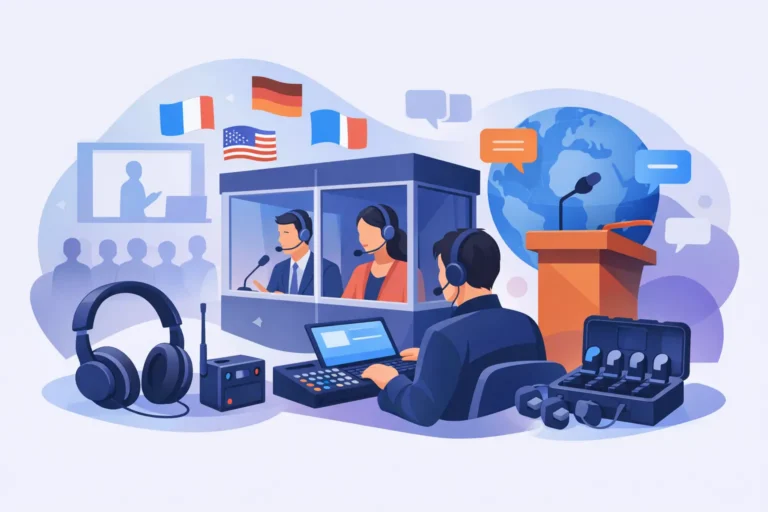
A simultaneous interpretation system uses professional interpreters, interpreter consoles, sound-isolated booths where required, transmitters, and attendee receivers or headphones. Interpreters listen to the floor language and deliver the target language in near real time.
This remains the strongest option for formal conferences, legal or policy discussions, executive presentations, technical training, and subjects where nuance matters. Experienced interpreters understand context, adjust to a speaker’s pace, and recognize when a term has a specific cultural, commercial, or regulatory meaning. They can also manage the imperfect delivery that is common in live events, including accents, interruptions, incomplete sentences, and speakers who depart from the script.
The trade-off is planning. Organizers must schedule interpreters by language pair, arrange booths and technical infrastructure, and manage receiver distribution. Costs increase as language channels, attendee numbers, and operating hours grow. Yet for an international summit where accuracy and participant confidence are non-negotiable, this investment is usually justified.
2. AI speech translation platforms
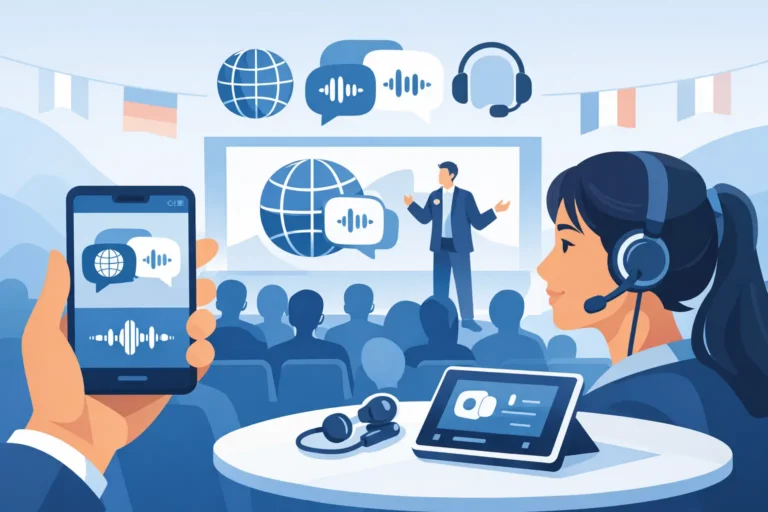
AI speech translation converts spoken language into translated text, audio, or both. Depending on the platform, attendees may use a QR code and their own smartphone, access captions on a display, or listen through dedicated devices.
The advantage is speed of deployment and broad language coverage. AI can be highly useful for internal town halls, general sessions, exhibitions, product demonstrations, site tours, training programs, and meetings where participants need practical understanding rather than legally precise wording. It can also provide live captions for accessibility and create translated transcripts after the session.
However, AI is not a direct replacement for professional simultaneous interpreters in every setting. Results vary according to the speaker’s accent, microphone quality, subject vocabulary, speaking speed, overlapping voices, and background noise. Brand names, technical acronyms, figures, and Arabic-English code switching can require preparation and active monitoring.
For best results, provide the platform with speaker names, agendas, key terminology, product names, and approved translations before the event. Use professional microphones rather than room audio, and assign a technician to confirm that captions, audio output, and attendee access are functioning throughout the program.
3. Remote simultaneous interpretation
Remote simultaneous interpretation connects interpreters working from a remote location to the event’s audio and video feeds. Participants receive their selected language through a web platform, event app, or integrated interpretation system.
This format can be an effective choice for hybrid meetings, multi-city programs, and events requiring less common language pairs. It can reduce travel requirements and give organizers access to a wider interpreter pool. It also supports a flexible program structure when some speakers and attendees join remotely.
Its main dependency is connectivity. Remote interpreters need stable, high-quality audio and video, while attendees need a reliable path to their language channel. A venue’s guest Wi-Fi may be suitable for basic browsing but insufficient for hundreds of participants streaming translated audio at the same time. Dedicated internet capacity, network testing, backup connectivity, and clear escalation procedures should be part of the production plan.
How to Match the Tool to the Event Format
The simplest decision framework is to begin with the risk of misunderstanding. If a meeting includes contractual decisions, public policy, medical information, safety instructions, investor communications, or complex technical content, interpreter-led simultaneous interpretation is generally the appropriate standard.
If the purpose is broad access, fast deployment, or supporting a mixed-language audience during an internal event, AI translation may be the more practical choice. It is particularly effective when organizers can control the audio environment and prepare terminology in advance.
Remote interpretation is often the right middle ground for hybrid programs. It gives events access to professional human interpretation while allowing teams and speakers to operate across locations. It needs more technical preparation than many organizers expect, especially when the main room includes video playback, audience microphones, walk-in music, and multiple presentation sources.
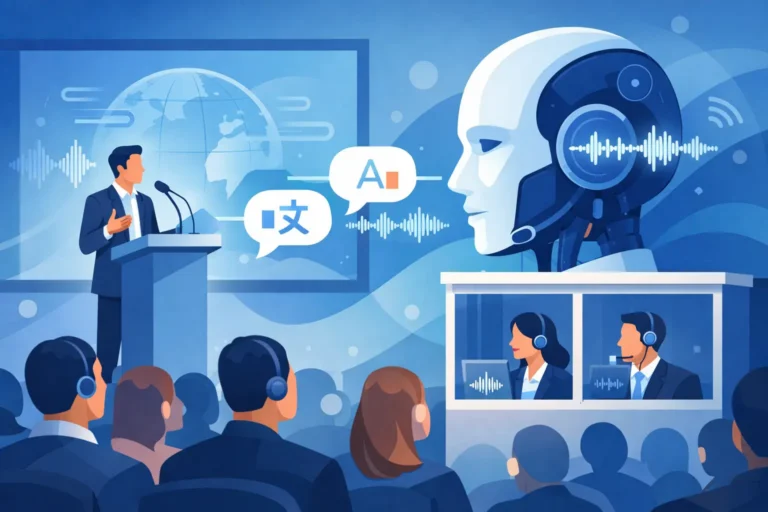
For larger events, a combined approach can be more effective than selecting one system for every participant. A main conference room may use interpreters and infrared receivers for official language channels, while AI captions support overflow spaces, exhibition activations, or informal breakout sessions. This approach protects accuracy where it matters most and expands access where flexibility is more valuable.
Questions to Ask Before Renting a Translation System
Before confirming equipment, identify the number of active languages, expected attendance by language, venue room count, session schedule, and whether attendees will be in person, remote, or both. These details determine the required number of interpretation channels, receiver units, charging stations, distribution staff, and technical operators.
Also ask how questions will be handled. A bilingual keynote is relatively straightforward. A moderated discussion with roaming microphones, audience Q&A, video contributors, and remote panelists requires a coordinated audio workflow. Every participant must be heard clearly by the interpreter, the room audience, and online attendees without creating echo or feedback.
Venue conditions matter as well. Exhibition halls and ballrooms may contain competing noise, structural interference, or long distances between the technical control position and audience areas. A professional site survey identifies where to place transmitters, booths, receivers, network equipment, and staff stations before guests arrive.
Finally, establish ownership of the attendee journey. If guests use their phones, communications must explain how to connect, which browser or app is required, and whether headphones are needed. If dedicated receivers are used, plan registration, handout, collection, sanitization, charging, and spare inventory. The best technology still needs a clear front-of-house process.
Why Managed Technical Support Changes the Result
Translation systems are not just rental items placed on a table. They operate alongside conference microphones, presentation audio, video switching, recording, room acoustics, and venue network services. A managed setup gives the production team one accountable technical partner for configuration, testing, live operation, troubleshooting, and post-session equipment handling.
DLC Events can configure translation and interpretation packages around the actual program rather than supplying a fixed set of devices. That may include interpreter booths and consoles, infrared or digital receivers, AI speech translation, remote interpretation connectivity, discussion microphones, professional audio, and technical crew support. This is especially valuable when a program moves between plenary sessions, workshops, and hybrid broadcasts.
A reliable setup also includes contingency planning. Spare receivers, replacement headsets, backup microphones, charged batteries, redundant audio paths, and an experienced operator can prevent a minor issue from becoming a visible interruption. For international events, confidence comes from knowing the language system has been tested before the first delegate takes a seat.
The right live translation solution is the one that lets every attendee follow the conversation with confidence. Start with the message, the audience, and the consequences of getting it wrong, then build the technical package around the event rather than forcing the event to fit the technology.