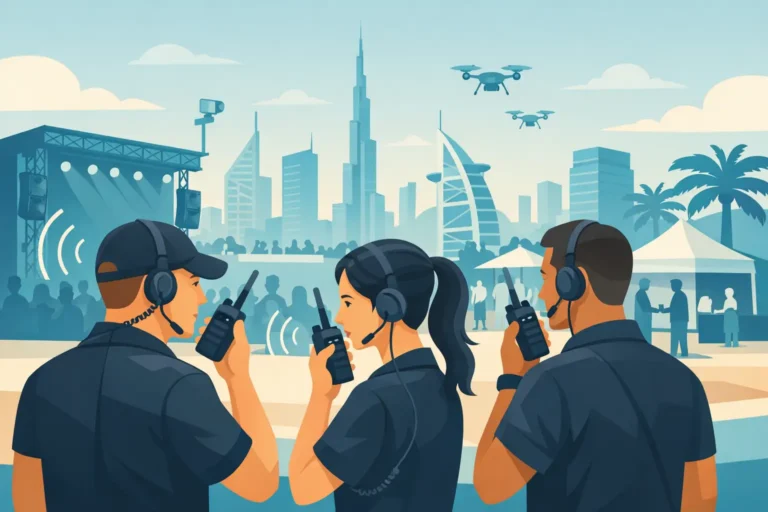
A missed cue at a conference can hold up registration, delay a speaker entrance, or leave a production team reacting instead of directing. For organizers arranging a two way radio rental Dubai deployment, the objective is not simply to put radios in staff hands. It is to create a clear, licensed, and well-managed communications structure that keeps every event function connected.
From corporate meetings and exhibitions to multi-room summits and film shoots, radio communication gives teams the instant coordination that phone calls and messaging apps cannot always provide. The right rental package brings together suitable devices, accessories, channel planning, technical preparation, and on-site support around the way your event actually operates.
Why Event Teams Need Two-Way Radios
Large venues are busy, noisy, and often spread across several levels or halls. Registration, guest relations, security, audiovisual crews, stage management, catering, logistics, and venue operations all need to share updates quickly. A two-way radio provides push-to-talk communication without requiring staff to unlock a phone, search for a contact, or depend on a reliable cellular signal in every area of the venue.
The value is most visible when timing matters. A stage manager can confirm that a presenter is ready while the audiovisual operator prepares the next walk-on track. A floor manager can request additional guest support at an entrance. An exhibition supervisor can coordinate deliveries before doors open. These are short exchanges, but they prevent small problems from becoming visible disruptions.
Radios also create clearer operational boundaries. Instead of placing every staff member on one congested channel, teams can be grouped by function. Production may require its own channel, while registration and guest services operate on another. Event leadership can retain access to a designated management channel for escalations and priority decisions.
Two Way Radio Rental Dubai: What to Specify
The most effective rental solution begins with an operational brief, not a device count. Radio requirements depend on the size of the venue, the number of departments, the presence of public-facing staff, and whether the program runs across multiple rooms, days, or locations.
Start by identifying who truly needs a radio. Core users commonly include event managers, stage managers, AV technicians, security coordinators, logistics teams, registration leads, venue contacts, and client representatives. Giving radios to every person may seem safer, but it can create unnecessary channel traffic. A focused allocation is often more effective, with spare units available for unexpected needs.
Next, consider the venue environment. A ballroom program with a contained staff team has very different coverage needs from an exhibition across several halls, a resort-wide incentive program, or an outdoor activation. Building materials, basements, loading areas, parking zones, and distance between event spaces can all affect radio performance. A site review and practical coverage assessment reduce assumptions before event day.
For professional use, the package should also include the accessories that suit each role. Earpieces help guest-facing teams communicate discreetly. Speaker microphones allow technical and logistics staff to operate radios while moving equipment. Headsets may be preferable in loud back-of-house areas. Chargers, spare batteries, and clearly labeled units keep the system usable throughout a long production schedule.
Licensed Communications Matter in the UAE
Radio use in the UAE is regulated. Organizers should not assume that consumer walkie-talkies, imported units, or uncoordinated frequencies are appropriate for a professional event. Frequency authorization and compliant operation are key considerations, particularly for high-profile events, government programs, public venues, and large teams.
A TDRA-licensed radio communications provider can advise on the correct approach and supply equipment configured for the deployment. This helps protect the event from interference, unapproved use, and last-minute operational uncertainty. It also means the radio plan is treated as part of the production infrastructure, rather than an afterthought collected from different sources.
Build a Channel Plan That People Can Use
A radio system is only as useful as the team’s ability to use it under pressure. The channel plan should be simple enough for staff to remember and disciplined enough to avoid constant interruptions.
For a corporate conference, that may mean one channel for production, one for event operations, one for security, and a management channel reserved for supervisors. For a major exhibition, additional channels may be required for registration, exhibitors, logistics, VIP services, or individual halls. The right number depends on the structure of the team. Too few channels lead to congestion; too many can confuse occasional users.
Assign channel names or numbers consistently, and brief each department before doors open. Staff should know which channel is their working channel, when to contact event control, and how to keep transmissions concise. A useful radio call states who is being called, where the issue is, and what support is required. For example: “Registration lead to operations, additional staff required at the east entrance.”
Radio etiquette is not about formality. It protects airtime when multiple teams are working at once. Ask staff to pause before speaking, avoid long explanations on shared channels, and move detailed conversations to a separate channel where appropriate. Clear call signs are particularly helpful on multi-day events with rotating crews.
Rental Support Beyond Equipment Delivery
Professional radio rental should account for the full event timeline: pre-event planning, delivery, distribution, operation, and collection. Equipment arriving in a case without a channel plan, charging strategy, or technical contact can leave the organizer carrying the operational risk.
A managed approach can include radio configuration, channel allocation, unit labeling, battery charging, accessories, delivery to the venue, and an on-site technician when the event requires it. On larger programs, a technician can assist with distribution, replace damaged or depleted units, and coordinate additions as team numbers change.
This is especially valuable when a production has early access, overnight build days, or a program that runs into the evening. Battery management is often underestimated. A radio fleet must be charged, issued, tracked, and returned in a controlled way, with spares ready for long shifts. For critical teams, spare batteries or charging rotations may be more practical than asking staff to conserve use during the day.
DLC Events provides configurable two-way radio rental packages supported by experienced technical teams, with licensed radio communications for professional event operations in Dubai and across the region. The requirement may be a practical set of radios for a workshop or a coordinated communications plan for a complex summit, exhibition, or live production.
Choosing the Right Radio Setup for Your Event
There is no single radio specification that suits every event. Compact handheld radios work well for many event operations because they are portable and quick to issue. Higher-capacity systems may be required for extended coverage, larger user groups, or demanding production environments. The decision should be based on working conditions, not just the number of attendees.
For guest-facing staff, comfort and discretion can matter as much as range. A lightweight earpiece and a radio carried under a jacket may be preferable at a formal leadership event. For loading docks, outdoor sites, and production crews, a speaker microphone and durable belt attachment can be more practical. In loud environments, audio clarity and suitable hearing accessories deserve particular attention.
It also helps to distinguish two-way radios from show intercom. Radios are ideal for mobile departments spread across a venue. Show intercom is designed for tightly coordinated technical crews such as camera operators, directors, stage managers, lighting, and audio personnel who need continuous, immediate production communication. Complex events may require both systems, each serving a different operational purpose.
Plan Early, Then Scale as Needed
Booking early is advisable when an event needs a substantial number of radios, specialized accessories, licensed frequencies, or support across multiple days. Early planning allows the technical team to assess the venue, reserve the right inventory, and coordinate with production, security, and venue management.
That said, professional rental should remain flexible. Delegate numbers change, additional halls open, and clients may add evening functions or external activations. A capable provider can scale the package with additional radios, batteries, chargers, and accessories when availability permits. Communicating likely changes in advance gives the team the best chance to respond quickly.
The most reliable event communications plan is the one your staff can use without thinking about it. When radios are licensed, configured, charged, and matched to each team’s role, your people spend less time chasing updates and more time delivering the experience guests came for.