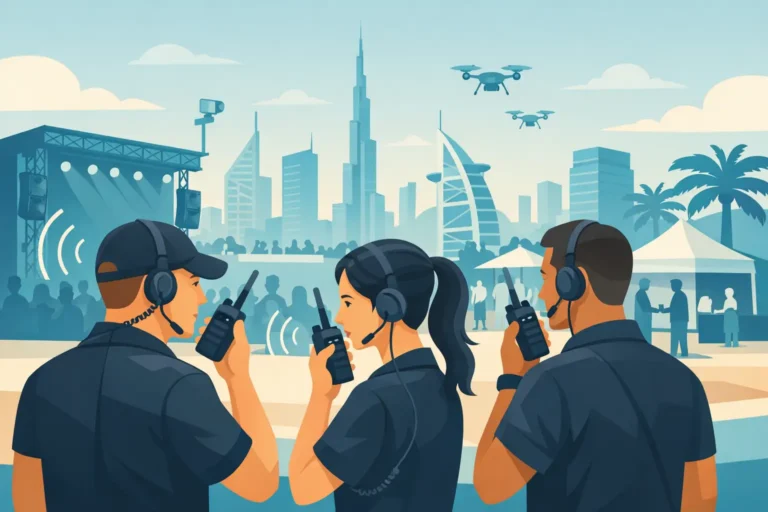
A guided group can lose its connection in seconds. A noisy exhibition aisle, an active construction site, a large factory floor, or the walk between venues can make even an experienced guide difficult to hear. Tour guide system rental Dubai gives every attendee a clear audio connection, allowing guides to speak at a natural level while guests follow the program without crowding around the presenter.
For corporate visits, government delegations, exhibitions, training programs, and VIP hospitality, the right system does more than amplify a voice. It creates a more organized experience, supports controlled movement through busy locations, and gives organizers confidence that key information will reach the full group.
When a Tour Guide System Is the Right Choice
A tour guide system is designed for one-to-many communication while a group is moving. The guide uses a lightweight wireless transmitter and microphone, while each participant receives audio through an individual receiver and headset or single-ear earpiece. Unlike a portable loudspeaker, the system does not add sound to the room. That matters in public venues, operating facilities, museums, exhibition halls, and locations where discretion or noise control is required.
It is particularly effective when attendees need to hear commentary while walking, standing at a distance, or viewing equipment that cannot be approached closely. On a manufacturing or logistics site, for example, attendees may need to remain behind a safety line. During an exhibition tour, a guide may need to explain a stand without competing with neighboring demonstrations. For an executive site visit, the system keeps the group moving efficiently without repeated stops to gather everyone around the speaker.
A conventional wireless microphone system can be useful for a stationary presentation, but it is not a substitute for individual receivers. The audience still depends on loudspeakers, room acoustics, and proximity to the guide. A tour guide system is built for mobility and personal listening.
Planning Tour Guide System Rental Dubai Around Your Group
The correct rental package begins with the event environment, not simply the number of attendees. A 20-person executive tour inside a quiet gallery requires a different approach from a 150-person delegation moving through a live industrial facility. The equipment count is only one part of the plan.
Start by confirming how many guides will speak at the same time. One lead guide normally requires one transmitter and a receiver for each participant. If groups will split by language, route, or agenda, each guide needs a separate transmitter and a dedicated channel. This allows attendees to select the relevant guide without hearing another group nearby.
The listening format also affects the guest experience. Single-ear earpieces are practical when participants need to remain aware of their surroundings, such as during a site tour or exhibition walk. Lightweight headphones can offer more isolation in louder settings, although they may be less convenient in hot outdoor conditions or where guests are expected to interact frequently with staff.
Battery planning should match the full operational schedule, including registration, travel between stops, waiting time, and any repeated sessions. A system that covers a one-hour tour may not be appropriate for a full-day program with multiple group rotations. For larger deployments, organizers should also plan a controlled distribution and collection point so every receiver is issued, tracked, sanitized where required, and returned efficiently.
The Venue Changes the Technical Plan
Dubai programs often combine several environments in one day: a hotel briefing room, coach transfer, exhibition visit, waterfront location, or active site. Each location can introduce different signal and operational considerations. Concrete structures, large machinery, dense wireless activity, and long routes can all influence system placement and channel planning.
A professional supplier should review the venue route, group size, expected noise level, and timing before recommending equipment. For high-profile or complex programs, an on-site technical crew can manage setup, distribution, frequency coordination, and support throughout the visit. This is especially valuable when event staff must focus on guests, protocol, security, or the production schedule rather than equipment handling.
Choosing Features That Matter in the Field
Not every tour requires the same specification. The most useful features are those that solve a genuine operational issue rather than adding complexity. A practical package may include:
- Multiple channels for parallel tours, language groups, or separate visitor routes
- Headworn or lapel microphones suited to the guide’s movement and presentation style
- Charging cases or spare batteries for extended schedules and repeat sessions
- Receiver numbering and organized cases to speed up issue, collection, and inventory control
- On-site technical support for large, VIP, multilingual, or high-risk programs
For a small, single-language group in a controlled venue, a straightforward transmitter, receivers, and earpieces may be all that is needed. For a multi-group summit tour, an exhibition delegation, or a government visit with protocol requirements, the package may need multiple channels, dedicated technicians, branded distribution points, and coordination with wider event communications.
There is also a trade-off between flexibility and simplicity. More channels support more simultaneous groups, but they require clearer attendee instructions and tighter coordination. Full headphones can improve audibility in loud spaces, while single-ear solutions make it easier for guests to talk with one another. The right choice depends on the route, the audience, and the level of interaction expected.
Supporting Multilingual Tours and Delegations
A tour guide system can support multilingual communication, but organizers should distinguish between guided audio and formal simultaneous interpretation. If a guide can deliver the same route in separate languages to separate groups, multiple tour guide channels may be enough. This approach works well for multilingual exhibition tours, familiarization visits, and facility walkthroughs.
When one speaker must be interpreted live into several languages for the same audience, a dedicated simultaneous interpretation system may be more appropriate. That setup typically involves interpreters, language channels, interpretation consoles, and receivers configured for language selection. The decision depends on whether guests are following different guides or listening to the same presentation through live interpretation.
For hybrid or broadcast-sensitive programs, audio from the guide may also need to feed a recording system, camera crew, or remote audience. This should be planned in advance. A tour guide transmitter is excellent for audience listening, but production audio often requires additional interfaces, microphones, mixers, or record feeds to achieve the required quality and control.
Why Rental Makes Operational Sense
Purchasing equipment may look attractive for organizations that host frequent tours, but ownership brings responsibilities that are easy to underestimate. Equipment must be stored, charged, maintained, cleaned, counted, tested, and replaced as battery performance and technology change. Internal teams also need to understand channel setup, receiver allocation, troubleshooting, and loss management.
Rental gives organizers access to a package sized for the actual event. A team can deploy 30 receivers for a board delegation one week and several hundred units for a conference excursion the next, without carrying the capital cost or maintenance burden of a large inventory. It also allows the technical configuration to change with each venue and format.
DLC Events supports tailored tour guide system packages with equipment preparation, delivery, setup, and technical assistance based on the scale and operating requirements of the program. For complex event schedules, that support can reduce pressure on the organizer’s registration, guest-relations, and production teams.
Common Questions Before Booking
How far in advance should a system be reserved?
Early booking is recommended for major conferences, exhibition periods, government programs, and dates requiring large quantities or multilingual channels. Smaller requirements may be available at shorter notice, but advance planning provides more time for route assessment, crew scheduling, and equipment preparation.
Can guests use their own headphones?
Sometimes, depending on the receiver connection and the event’s hygiene and guest-experience requirements. However, supplied earpieces ensure compatibility and simplify distribution. For VIP or branded events, organizers may choose a specific headset style that aligns with the guest experience.
What happens if a receiver fails during a tour?
Professional planning includes tested equipment and, where appropriate, spare units. For larger or high-stakes programs, an on-site technician can replace equipment quickly and address issues before they affect the group.
A well-planned guided visit should feel controlled, not technical. Confirm the route, the number of speakers, the languages, the noise conditions, and the handover process early, then let the communication system do its job quietly in the background.