A multilingual conference can have excellent speakers, a polished stage, and a full agenda, yet still fail its international audience if interpreters cannot clearly hear, see, or work comfortably. Interpreter booth requirements are not a minor venue detail. They determine whether simultaneous interpretation remains accurate throughout the program and whether every delegate receives the language channel they need.
For conference producers, corporate teams, and government event departments, the right approach is to plan the booth as part of the complete communication system: room design, stage sightlines, microphone routing, audience receivers, technical staffing, and contingency planning. A suitable booth protects interpreter concentration while giving them immediate access to the event as it happens.
Start With the Event Brief
The booth specification should follow the event, not the other way around. Before selecting equipment or allocating floor space, confirm the number of spoken languages, the expected audience by language, session duration, room layout, and whether the agenda includes panel discussions, video playback, audience Q&A, or remote speakers.
Languages, channels, and interpreter teams
Each target language normally requires a dedicated interpretation channel and a dedicated booth. In most cases, two interpreters share each language booth and alternate during the session. Long programs, highly technical subject matter, or high-intensity sessions may require additional interpreters and a rotation schedule.
Do not assume that three languages mean three booths. If English is the main floor language and interpretation is required into Arabic, French, and Spanish, three booths may be needed. If presenters will also speak in Arabic or French, the language routing and relay plan need more careful design. The interpretation provider, interpreter coordinator, and technical team should agree on this plan before setup day.
Conference, hybrid, or broadcast format
A live conference in one ballroom has different needs from a multi-room summit or a hybrid program. For hybrid events, interpreters may need to hear the room, remote participants, playback content, and moderator cues. They may also need camera returns to identify the active speaker when the stage is not continuously visible.
Remote interpretation can be a practical alternative where travel, space, or scheduling makes physical booths difficult. However, it depends on stable, managed network connectivity, appropriate audio feeds, backup paths, and trained operators. It should be designed as an integrated workflow, not added after the event platform is already configured.
Interpreter Booth Requirements for Space and Placement
Booth location is one of the most consequential decisions in the room. A booth should give interpreters direct, unobstructed sightlines to the speaker area, presentation screens, and any audience position used for questions. A distant booth with a partially blocked view creates avoidable pressure, particularly during unscripted discussion or fast-moving panel exchanges.
Sightlines are operational, not decorative
Interpreters need to see who is speaking, observe body language, follow demonstrations, and recognize when a moderator changes the floor. Place booths at the rear or side of the room only if the viewing angle remains clear. Avoid locating them behind scenic elements, under low ceiling features, or where cameras, lighting positions, or standing delegates can obstruct the view.
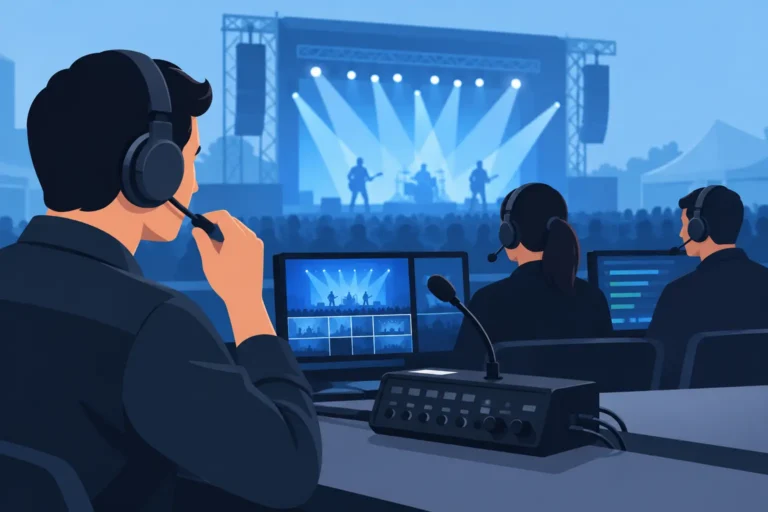
If the room design makes direct sightlines impossible, provide high-quality low-latency video monitors inside each booth. These monitors should show a useful program view, not simply a wide camera shot where speakers are difficult to identify. For complex conferences, a separate presentation return can help interpreters follow slides, charts, and videos accurately.
Booth dimensions, construction, and access
Professional simultaneous interpretation booths should comply with the appropriate applicable standard, commonly ISO 4043 for mobile booths or ISO 2603 for permanent installations. As a planning baseline, a mobile booth must provide adequate working room for two interpreters, their consoles, documents, water, and headsets without restricting movement or ventilation.
A quality booth is enclosed, acoustically treated, internally lit, and fitted with quiet ventilation. It should have a stable work surface, comfortable chairs, transparent front panels, and a door that closes securely without excessive noise. Open tables at the back of a room are not interpretation booths. They expose interpreters to audience noise, distract from concentration, and allow their voices to affect the room.
Allow clear access behind and beside the booths for interpreters and technicians. Booth doors should not open into an evacuation route or create congestion in a narrow service corridor. The venue team should also confirm power availability, ceiling clearance, loading access, and any restrictions on temporary structures before the floor plan is finalized.
Keep noise and temperature under control
Interpretation requires sustained concentration. Avoid positioning booths next to loud air-conditioning outlets, catering stations, entrance doors, production comms positions, or backstage traffic. Even a low-level mechanical hum can become exhausting during a full-day program.
Ventilation is equally critical. A closed booth occupied by two people and electronic equipment becomes uncomfortable quickly if air circulation is insufficient. Booth fans or air-conditioning must operate quietly enough that they do not enter the interpreter microphone path. This is a practical reason to use purpose-built conference booths rather than improvised enclosures.
Audio Requirements That Protect Meaning
An interpreter can only deliver a reliable translation from a clean source signal. The main microphone mix must be intelligible, consistently leveled, and free from avoidable feedback, room echo, or sudden level changes. Every presenter, moderator, and audience participant expected to speak should use an appropriate microphone.
Interpreter consoles and source feeds
Each booth requires professional interpreter consoles, headsets, and microphone control. The console allows interpreters to listen to the floor language, speak into their assigned channel, adjust listening volume, and manage handover between partners.
The audio feed should include every relevant source: lectern microphones, panel microphones, handheld Q&A microphones, video playback, remote contributors, and any language relay required by the program. Playback content deserves special attention. A video may sound clear in the room while its embedded audio is missing or too quiet in the booth unless it has been specifically routed and tested.
Technical teams should also provide a clear communication path for essential production cues. This should be managed carefully. Interpreters need relevant information, such as a speaker change or video start, but their program feed should not be cluttered with unnecessary backstage communications.
Audience receivers and language selection
Delegates need a straightforward way to receive their chosen language channel. An infrared or digital wireless interpretation system typically includes transmitters, radiators or access points, receivers, and headphones. Channel labels should match event signage, attendee instructions, and the language plan used by registration staff.
Receiver quantities should reflect actual language demand rather than total attendance alone. A 500-person conference may need 500 receivers if every attendee requires interpretation, or substantially fewer if most delegates follow the floor language. Order additional units for late registrations, VIP movement, replacements, and operational spares.
Plan Testing Around the Real Agenda
A successful technical check is more than confirming that a headset produces sound. Test with the actual microphone positions, video content, presentation computers, remote guests, and room lighting conditions. Ask interpreters or their coordinator to assess audibility, sightlines, screen visibility, booth comfort, and channel routing before doors open.
For high-stakes meetings, the production plan should cover four operational points:
- A full line check from every speaking position to every required interpretation channel.
- Backup headsets, receivers, batteries or charging capacity, and critical signal paths.
- A technician assigned to monitor interpretation equipment during live sessions.
- A clear escalation route if a language channel, console, or source feed requires immediate attention.
This support matters most when the agenda changes. A last-minute video, an impromptu audience question, or a speaker joining remotely can affect every language channel. An experienced crew can adapt routing and resolve faults without interrupting the delegate experience.
Consider the Room as One System
Interpreter booths are often specified late because they occupy visible floor space. That is understandable, especially in a tightly branded ballroom or exhibition hall. But moving booths to an unsuitable location to preserve a design concept creates a greater risk than adjusting seating, scenic elements, or camera placement early in the process.
The most effective design brings venue management, interpreters, AV production, conference technology, and event organizers into the same planning conversation. DLC Events supports this process with configurable interpretation systems, professional booths, delegate receivers, technical setup, and on-site operation for events in Dubai, across the GCC, and internationally.
Give the booth team the same planning attention as the stage and sound system. When interpreters have a quiet workspace, clear visual information, dependable audio, and responsive technical support, multilingual communication feels natural to every person in the room.